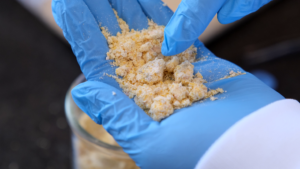
Picture: Moldy Corn Samples from Ralco’s Mycotoxin Lab
This year’s inconsistent growing conditions across the Corn Belt may increase mycotoxin risk in swine feeds. As corn moves through the supply chain, managing that risk becomes essential to protect pig intake, health and performance.
With input from Ralco’s PhD swine nutritionists, this article breaks down this year’s mycotoxin risks and compares mitigation tools like binders and biological enzymes to help guide your mycotoxin strategy.
What Are Mycotoxins and Why You Can’t “Get Rid” of Them
Mycotoxins are toxic compounds produced by certain molds that grow on grains, especially corn. Once present, they can’t simply be washed off, heated up or easily removed mechanically.
When mycotoxins show up in a finishing barn, issues can escalate fast. Waiting it out can lead to ulcers, secondary infections and even higher mortality. And because there’s no way to know how long the problem will last, reactive fixes like dumping feeders and vacuuming bins are costly, slow and disruptive.
Not having a plan comes with a big economic risk. And trying to “clean up” contaminated corn rarely works, and when it does, it’s expensive.
Instead, producers should rely on strategies that bind or biologically modify mycotoxins so they pass through the animal without causing harm. These strategies don’t eliminate mycotoxins from feed, but they can help protect pigs from their harmful effects.
Why Mycotoxins Are a Bigger Concern in 2025
Weather plays a big role in which mycotoxins show up in feed. In the southern and eastern Corn Belt, hot, dry weather followed by humidity could encourage the development of aflatoxin and fumonisin this year.
In contrast, the northern and western Corn Belt has seen wetter than average conditions, which can lead to increased levels of DON (vomitoxin) and zearalenone.
Even if corn looks clean, it may not be safe. Mycotoxins can remain in the grain long after visible mold has disappeared.
Since corn often travels across state lines, understanding the geographic source of your grain is important. Because this is not always possible, it heightens the importance of some level of mycotoxin protection in your complete feed.
Check the latest drought monitor for your area.
Common Mycotoxins to Watch For in 2025
While many different mycotoxins can appear in feed, a few are particularly relevant for swine this year and several of them have already been found in samples arriving at our Ralco labs:
- DON (vomitoxin): Reduces swine intake and performance, especially in nursery pigs.
- Zearalenone (ZEN): Causes reproductive failure, most notably in sows.
- Fumonisin: Affects gut health and can cause pulmonary edema (a fatal respiratory condition).
- T2/HT-2: Can cause ulcers and necrosis in the mouth, esophagus and throughout the gastrointestinal tract. Also inhibits protein synthesis and suppresses immune function.
- Aflatoxin: Damages liver and suppresses immune function.
Each toxin behaves differently in the pig’s body. For example, DON is excreted rapidly, but that doesn’t make it less harmful. ZEN, on the other hand, can persist in tissues for days.
What Pigs Are at the Highest Risk of Mycotoxins
Not all pigs respond the same way to mycotoxin exposure. Nursery pigs are the most sensitive, and even low levels of DON can reduce intake and performance. Sows face the greatest reproductive risks, particularly with ZEN exposure. Grow-finish pigs may tolerate moderate levels of contamination, but they can still experience losses in gain and efficiency.
Identifying your toxin levels and applying that knowledge to the tolerance levels of your herd can help you decide which potential mitigation strategy to implement.
Not All Mycotoxin Mitigation Strategies are Created Equal
When a mycotoxin challenge hits, producers have multiple tools to work with, each with its own advantages and disadvantages.
1. Binders
Traditional binders (such as clays or silicates) can be effective against certain mycotoxins, like aflatoxin. Their ability to bind structurally diverse mycotoxins and hold onto them as they move through the digestive tract is key to reducing exposure and maintaining pig health.
However, not all binders perform the same way. For example, Ralco’s IntegraFlo has been extensively evaluated for its ability to bind multiple toxins under both acidic and neutral pH conditions. This ensures it continues to bind toxins as feed moves through the digestive tract.
In an in vitro study conducted at the University of Missouri Veterinary Medical Diagnostic Laboratory, IntegraFlo demonstrated:
- 100% binding efficiency of aflatoxin at inclusion rates of 2–12 lb./ton, with no desorption detected.
- 60–80% binding of zearalenone at 8–12 lb./ton, outperforming a commercial comparison product.
- 40–60% binding of ochratoxin A at 8–12 lb./ton.
- 50% binding of DON (vomitoxin) at 8-12 lb./ton.
Depending on the type of binder, binding efficiency isn’t always 100%, and some may also bind essential nutrients. They may be less effective against polar toxins like DON or ZEN. That’s why many producers rely on targeted solutions or combination strategies with binders to address specific toxins more effectively. Nonetheless, IntegraFlo’s strong binding efficiency makes it a dependable foundation for a mycotoxin management program.
Overall, binding agents serve as a strong “insurance policy”, often capitalized on in many feeding programs. While they may not be as targeted as other solutions, they offer consistent, proven value in managing background toxin pressure, something producers face nearly every year.
Since multiple mycotoxins often occur together, using a broad-spectrum binder as the base layer of defense allows producers to layer on more targeted enzyme or probiotic solutions (highlighted in the next section) only when needed, helping manage costs while maintaining protection.
2. Chemical, Enzyme and Probiotic Modification
These are a few of the fastest-growing research areas in feed mitigation. These additives chemically modify mycotoxins, transforming them into less harmful compounds. Their effectiveness depends on the specific toxin and how the feed is processed. There are several enzymes and probiotics available that each target specific toxins and modify them in such a way so the toxicity is reduced.
Some specific probiotic bacteria strains, often from the genus Lactobacillus and Streptomyces, can detoxify aflatoxins through either binding, adsorption or degradation. (3) These “good microbes” can grab onto toxins or break them apart, preventing them from being absorbed.
Various yeast species have also been investigated for the ability of its cell walls to absorb and bind mycotoxins. The effectiveness of a yeast-based probiotic depends heavily on cell wall integrity. For example, when the wall structure is compromised, detoxification efficacy drops below 50%. This highlights an important area for continued research into how yeast can best support mycotoxin mitigation. (4) In simple terms, the yeast cell wall acts like a sponge, soaking up toxins before the animal can absorb them.
Enzymes offer a unique approach to mycotoxin removal in a targeted manner. Mimicking gastrointestinal conditions, Tso and colleagues highlighted mycotoxin removability differences between various enzyme products against DON and ZEN. These enzymes act like precise tools, cutting or transforming toxins into forms that are less harmful to the animal. (5)
An effective example of a non-enzymatic chemical modification is the sulfonation of DON, which can reduce how much of the toxin the pig’s body absorbs.
Research shows that adding sodium metabisulfite (SMBS) can convert DON into DON-sulfinate (DON-S), a less harmful form of the toxin. (1) Nursery pigs can benefit from this approach, although a small amount of DON-S may still be absorbed and negatively affect production. Finisher pigs, on the other hand, are better able to excrete DON, making this strategy particularly effective in grow-finish diets. (2)
These solutions are powerful but are not a one-size-fits-all approach. Each binder, chemical compound, enzyme or probiotic targets specific toxins, so using the wrong product, or not enough product, can limit effectiveness. A combination of toxins can often be found simultaneously, so implementing multiple strategies may be required.
3. Feed Management
Lastly, beyond binders and targeted treatments, how feed itself is managed can play a major role in controlling mycotoxin exposure. While these strategies don’t remove toxins from the grain, they can help reduce risk when paired with a solid mitigation plan.
- Blending: Mixing contaminated grain with clean grain is a common practice that can bring overall mycotoxin levels below critical thresholds. But this comes with risk. “Hot spots” can still cause issues, and mycotoxins can ‘stack’ on top of one another. Even if individual toxin levels are lower after blending, their combined effects can still be harmful to pigs. Adding some level of protection from a mitigation strategy is still recommended in this case.
- Targeting by age: Sometimes contaminated grain at lower concentrations can be fed to more tolerant pigs, but never without testing and careful monitoring. Even then, mycotoxin protection is still advised.
Build a Targeted Mitigation Strategy
In many cases, multiple products are needed to address different mycotoxins, which can quickly increase feed costs. However, working with a nutrition company to routinely test your feed ensures you’re addressing the right toxins with the right tools, and investing where it matters most. With the proper technology in place, you can create a broad safety net that reduces the risk of health issues and performance losses tied to mycotoxin exposure.
And don’t just take your supplier’s word for it. Ask for mycotoxin testing results, review it and work with your nutritionist to build a clear mitigation plan. A little prevention can go a long way in saving time, money and frustration later on.
Ralco Can Help Test Your Feed for Mycotoxins
Whether you do or don’t suspect mycotoxins in your feed, testing is a critical first step. Ralco offers mycotoxin testing options and solutions based on the type and level of contamination. Let us help you build a better mitigation strategy!
Contact the Ralco Swine Team at 1 (800) 533-5306 or email SwineHelp@RalcoAgriculture.com to get started!
IntegraFlo for Swine
IntegraFlo™ is a swine feed additive designed for use when feed quality concerns arise, helping to restore vital nutrients and maintain overall animal health.
References:
- Shawk DJ, Dritz SS, Goodband RD, Tokach MD, Woodworth JC, DeRouchey JM. Effects of sodium metabisulfite additives on nursery pig growth. Transl Anim Sci. 2018 Aug 6;3(1):103-112. doi: 10.1093/tas/txy098. PMID: 32704782; PMCID: PMC7200424. https://pmc.ncbi.nlm.nih.gov/articles/PMC7200424/
- Becker LL, DeRouchey JM, Woodworth JC, Tokach MD, Goodband RD, Vidal A, Gougoulias C, Gebhardt JT. Evaluation of dietary mycotoxin control strategies on nursery pig growth performance and blood measures. Transl Anim Sci. 2022 Jun 14;6(3):txac081. doi: 10.1093/tas/txac081. PMID: 35813664; PMCID: PMC9263879. https://pmc.ncbi.nlm.nih.gov/articles/PMC9263879/
- Afshar, P.; Shokrzadeh, M.; Raeisi, S.N.; Ghorbani-HasanSaraei, A.; Nasiraii, L.R. Aflatoxins biodetoxification strategies based on probiotic bacteria. Toxicon 2020, 178, 50–58.
- Luo, Y.; Wang, J.; Liu, B.; Wang, Z.; Yuan, Y.; Yue, T. Effect of Yeast Cell Morphology, Cell Wall Physical Structure and Chemical Composition on Patulin Adsorption. PLoS ONE 2015, 10, e0136045.
- Tso, K.-H.; Ju, J.-C.; Fan, Y.-K.; Chiang, H.-I. Enzyme Degradation Reagents Effectively Remove Mycotoxins Deoxynivalenol and Zearalenone from Pig and Poultry Artificial Digestive Juices. Toxins 2019, 11, 599. https://doi.org/10.3390/toxins11100599