

As summer turns to fall nutritional value of grass declines. Nutritional value can’t be determined by the eye. Pastures may look green, but the protein and energy value of that forage has already been decreasing throughout the summer. By the time it’s obvious, cattle may have been running short on protein for weeks.
An Oklahoma State University (OSU) study tested this type of scenario with cattle grazing summer pasture as forage quality declined. This field trial utilized a rumen microbial supplement designed to help cattle pull more energy out of the declining forage.
However, to put the OSU trial results in context, let’s discuss three things first: why forage quality declines, how rumen microbes use protein and what happens to performance when protein runs short.
Late Season Forage Problem
Forage quality is tied directly to plant maturity, and quality only decreases as the season goes on. In alfalfa for example, crude protein runs around 25% in the bud stage, but by full bloom it’s dropped to about 16%, while fiber content climbs the entire time. (1) Meaning, as a plant matures, it builds more lignin, the tough structural tissue that gives the plant support, and less cellulose and hemicellulos, the soft, digestible leaf material it had early on, so fiber rises as protein falls.
Warm season grasses follow the same pattern, just from a lower starting point. Crude protein in warm season grasses is generally lower than cool season grasses. It declines further as the plant matures and as nitrogen fertilization drops off. Heavy rainfall makes it worse too, since it leaches nitrogen out of the soil before the plant can utilize it. (2)
By late summer into fall, much of what cattle are grazing has fallen below nutrient levels needed to maintain body condition, support growth or carry a cow through rebreeding. Protein needs also climb with both lactation and rate of gain, so lactating cows and faster-growing calves have increased nutrient demands. (2)
Cows need adequate protein this time of year to help maintain body condition heading into winter, since thin cows often struggle to rebreed in the spring. The rising nutrient demand of cows hits right as the grass has less and less protein to offer.
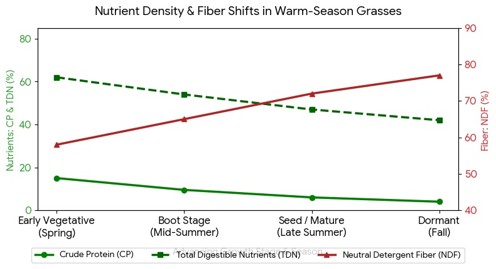
Chart source: Oklahoma State University Extension
This chart shows the tradeoff in real terms. As warm-season grass moves from early vegetative growth in spring to dormancy in fall, crude protein (green solid line) falls from around 15% to under 5%, while fiber content, measured as neutral detergent fiber (red line), climbs from around 58% to over 75%. Total digestible nutrients (green dashed line) decline right alongside protein. By the time a pasture looks dormant, it’s not just lower in protein, but lower in energy and harder to digest.
Science Behind Protein and Rumen Microbes
Not every kind of protein does the same job inside the animal. Before getting to what OSU found, it helps to understand the different forms protein takes and how each one is actually used.
- Crude protein (CP) is a measurement of nitrogen supplied in the feed. Crude protein is calculated by measuring the feed nitrogen content and multiplying by 6.25, since protein molecules run about 16% nitrogen on average. (3) Crude protein is divided into rumen degradable protein (RDP) and rumen undegradable protein (RUP).
- Rumen degradable protein (RDP) is broken down by rumen microbes into peptides, ammonia and free amino acids, which microbes use as their nitrogen source to grow and multiply. Microbes use RDP to breakdown fiber and release energy that’s utilized by the animal. As microbes reach their lifespan they are passed through the rumen into the small intestine supplying microbial protein to the hindgut where they’re broken down into amino acids for absorption. Microbial protein accounts for 60-85% of amino acids reaching the small intestine. (6)
- Rumen undegradable protein (RUP) is what escapes microbial degradation in the rumen. This bypass protein is available for breakdown in the lower digestive system and is available for maintenance, growth and reproduction. (3)
- Metabolizable protein (MP) is the net true protein absorbed by the small intestine. Requirements of MP vary with stage of production but is essential for growth and development.
Boosting Rumen Microbes, the Right Way and the Wrong Way
The rumen microbiome is remarkably productive when it’s stable, but diet is the single biggest factor that can disrupt it. (4) An abrupt diet change toward more fermentable, starch-heavy feed (like corn or other grain) can shift rumen pH downward as organic acids accumulate. This condition, known as acidosis, has a significant impact on microbial activity, rumen function and animal health and productivity. (4, 5)
When cattle begin to lose performance on late-season forage, a producer’s first instinct may be to increase energy or add more starch to the diet. However, if the forage is short on nitrogen, simply adding more energy doesn’t address the underlying issue. In fact, making a sudden change to the diet can further disrupt the rumen microbial population, which may already be struggling to efficiently utilize the available forage.
The more effective approach is to address what’s limiting microbial growth. That can mean supplementing protein directly, or it can mean using a technology like Microbial Catalyst that works on the rumen microbes themselves, increasing enzymatic reactions to break down cellulose, thus the microbial population that’s present converts more of the available fiber into usable energy.
What the OSU trial found is that these two approaches aren’t competing solutions, they’re complementary ones.
Inside the OSU Trial
The OSU trial was set up as a 2×2 factorial design utilizing 60 head grazing low-quality summer pasture. Trial ran roughly 60 days, ending in mid-September. Cattle were split into four groups: 1) no supplement, 2) protein only, 3) Microbial Catalyst only, and 4) protein plus Microbial Catalyst.
To keep the study conditions consistent, all cattle, including those that didn’t receive a supplement, were brought to individual stalls three times each week. This meant every group experienced the same handling and management, helping ensure that differences in performance could be attributed to the treatments rather than differences in how cattle were handled. Protein treatments were offered 1 lb. per head per day of a 40% crude protein supplement. Microbial Catalyst treatments were supplied at 3 grams per head per day.
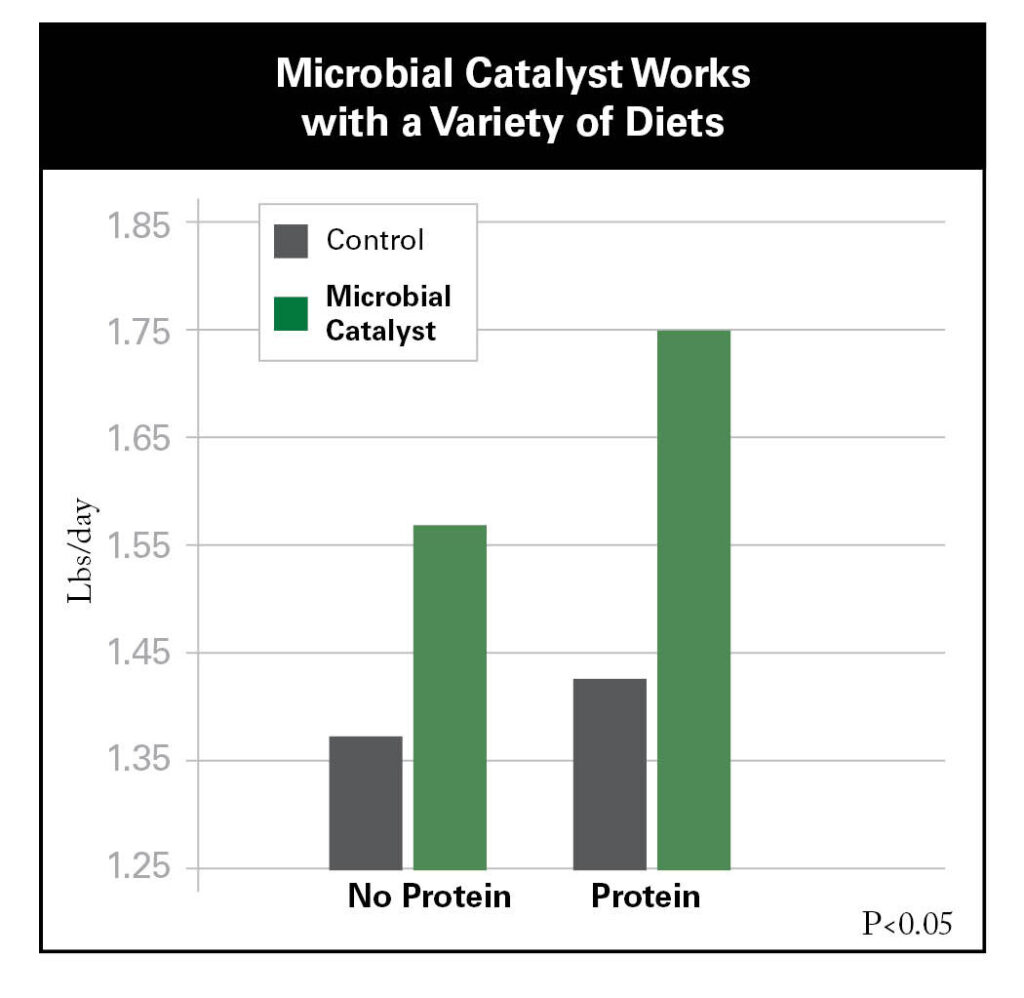
Results showed two things clearly:
- Microbial Catalyst worked on its own. Cattle receiving this treatment with no supplemental protein still gained significantly more than the unsupplemented controls, confirming the mode of action. Microbial Catalyst helped cattle pull more usable energy out of the same low-protein forage, without adding any other nutrient to the diet.
- Protein and Microbial Catalyst worked even better. Cattle receiving both gained more than either treatment alone. That additive effect makes sense given how the two work. Protein gave rumen microbes more nitrogen to grow and reproduce, and Microbial Catalyst activated microbes and enzymes used to breakdown cellulose. Thus were able to pull more total energy out of the same forage.
These micrographs, from a separate SDSU study on Microbial Catlayst, show forage fiber under magnification and illustrate what “breaking down more fiber” actually looks like. On the left, the control sample’s plant cell walls are still largely intact, dense material that’s hard for rumen microbes to break into. On the right, the Microbial Catalyst sample shows that same fiber structure visibly opened and broken down.
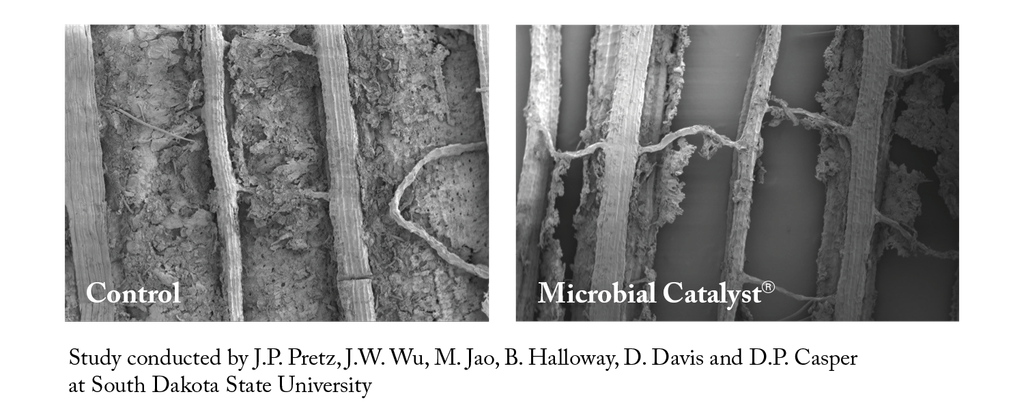
This is the mode of action described earlier and made visible. Microbial Catalyst enhances the enzyme activity microbes use to get inside tough plant cell walls, so more of that cellulose becomes accessible as usable energy rather than passing through undigested.
Economics from the Study
Over 60 days in the OSU study, Microbial Catalyst added 0.21 lb. of gain per head per day, or 12.6 lbs. of extra weight by end of the trial. Microbial Catalyst cost about $0.02 per head per day to feed or $1.20 per head for the feeding period. At a conservative $0.65 per pound value of gain, that 12.6 lbs. was worth $8.19 per head. That’s a strong return on a two-cent daily investment, and the return grew even larger when protein was added alongside.
Overall, this study’s low-quality summer pasture is exactly the scenario producers face every late summer and fall. It shows that producers aren’t stuck choosing between feeding protein or doing nothing at all. Microbial Catalyst improved performance alone, and improved it further paired with protein, giving operations a proven option that fits most budgets.
Microbial Catalyst technology is available in the product MC110 and can be added to your program through mineral, tubs, cake or liquid molasses.
Questions about protein supplementation or adding MC100 to your herd? Contact the Ralco beef team at 1-800-533-5306.
References
- Rocateli, A., Zhang, H. “Forage Quality Interpretations.” Oklahoma Cooperative Extension Service, PSS-2117. https://extension.okstate.edu/fact-sheets/print-publications/pss/forage-quality-interpretations-pss-2117.pdf
- Mississippi State University Extension Service. “Protein in Beef Cattle Diets.” Republished via The Beef Site. https://www.thebeefsite.com/articles/1542/protein-in-beef-cattle-diets
- Cappellozza, B.I. “A Guide to Protein Nutrition for Cattle.” Oregon State University Extension Service, 2013 (reviewed 2024). https://extension.oregonstate.edu/catalog/guide-protein-nutrition-cattle
- Cammack, K.M., Austin, K.J., Lamberson, W.R., Conant, G.C., Cunningham, H.C. “Ruminant Nutrition Symposium: Tiny but mighty: the role of the rumen microbes in livestock production.” Journal of Animal Science, 96(2):752-770, 2018. https://doi.org/10.1093/jas/skx053
- “Review: Ruminal microbiome and microbial metabolome: effects of diet and ruminant host.” Animal, ScienceDirect. https://www.sciencedirect.com/science/article/pii/S1751731119003252
- Hackmann, T.J., Firkins, J.L. “Maximizing efficiency of rumen microbial protein production.” Frontiers in Microbiology, 6:465, 2015. https://pmc.ncbi.nlm.nih.gov/articles/PMC10747152/