
For years, essential oils have lived in a gray area within livestock production. They’re talked about often yet still surrounded by misconceptions.
Many producers have heard claims like “all essential oils are the same” or that “they work only because they smell good.” Others assume that if a little is good, more must be better. And the biggest myth of all? Essential oils don’t have real research behind them.
As a company that has spent decades investing in essential oil technologies, chemistry and outcome-based research, we can confidently say science erases these misconceptions.
Essential oils are not commodities. They’re not perfumes. And when implemented correctly, they can support measurable improvements in health and performance, even in barns with no obvious challenges.
Growing Importance of Essential Oils in Modern Swine Production
Swine production has changed dramatically in the last 10–15 years. Antibiotic resistance continues to rise globally, customer expectations are shifting toward reduced antibiotic use and producers are left with fewer tools to navigate increasingly complex health and performance challenges. Even when barns are healthy, performance ceilings limit how much gain, feed efficiency and total carcass weight can be squeezed from a group of pigs.
That’s where essential oil technology becomes more than a “nice to have.” It becomes a strategic investment.
Producers need essential oil solutions that can:
- Deliver consistent results
- Target specific health challenges
- Support gut health without disrupting beneficial bacteria
- Provide stability through pelleting and feed manufacturing processes
Commodity essential oil extracts simply cannot do this. Here’s why.
Why Essential Oil Formulation Matters
The gut is a water-based environment, and essential oils, by nature, don’t mix well with water. It’s the classic oil and water problem. When oils aren’t properly formulated, they coalesce quickly, form droplets of inconsistent size and pass through the digestive tract without contacting the microbes they’re intended to target.
In other words, unprotected oils behave unpredictability. Some droplets may reach their target, and some may never have the chance if left unprotected. That inconsistency makes it nearly impossible to achieve reliable performance with commodity or traditional essential oils.
Ralco’s Microfused technology was developed to solve this exact challenge. By micronizing and stabilizing essential oils, our research shows that this technology allows them to disperse evenly in the gut and remain in suspension long enough to make consistent, targeted contact with pathogenic bacteria and feed the beneficial ones. The result is a stable solution with predictable results.
With fewer tools in producer’s toolboxes and more pressure on every pound of gain, investing in essential oil technologies that help pigs perform in both healthy and stressed environments matters more than ever.
The Goal of This Study
Producers often asked us the same question over and over: “Should essential oils be used in the nursery or the finisher to get the biggest performance boost?”
Our recommendation was to choose the stage that aligned with your goals. But after completing a recent study, the results made the answer remarkably clear: Pigs benefit most when essential oils are administered throughout their lifetime, not just in one phase.
To answer that question, we conducted a controlled study in a commercial nursery and grow-finish barn using four administration programs:
- Control + Control (no essential oils)
- NEO + Control (essential oils only in the nursery, none in grow-finish)
- Control + GFEO (essential oils only in grow-finish, none in the nursery)
- NEO + GFEO (essential oils in both nursery + grow-finish)
All pigs were healthy, and no disease challenge was introduced. Any improvements observed were strictly from performance enhancement, not recovery from induced sickness.
The results were clearer than expected.
The Results
Across all three essential oil administration programs, pigs performed better than the control group. But when technologies were administered in both phases of production, the response became additive, far greater than either stage alone.
Let’s walk through the key wean-to-finish performance metrics.
Average Daily Gain (ADG)
Pigs fed essential oils in both phases gained the most per day:
- Control: 1.80 lb./day
- Nursery only: 1.82 lb./day
- Grow-Finish only: 1.83 lb./day
- Nursery + Grow-Finish: 1.84 lb./day
Even when pigs aren’t facing health pressure, an extra 0.04 lb./day steadily pushes them toward market weight sooner.
Average Daily Feed Intake (ADFI)
Feed intake followed a similar pattern:
- Control: 4.35 lb./day
- Nursery only: 4.41 lb./day
- Grow-Finish only: 4.46 lb./day
- Nursery + Grow-Finish: 4.49 lb./day
Consistent increases in intake across each treatment group reinforces the idea that essential oils positively influence both early gut development and long-term feeding behavior.
Market Weight
Final market weight demonstrates the cumulative impact of better gain from higher intake:
- Control: 300.6 lb.
- Nursery only: 305.4 lb.
- Grow-Finish only: 305.4 lb.
- Nursery + Grow-Finish: 308.0 lb.
A nearly 8-lb advantage in pigs that never faced a health challenge, highlights just how much performance ceiling exists in healthy commercial barns.
Return Over Feed Cost (ROFC)
This is where the lifetime approach becomes even more compelling:
- Control: $162.26
- Nursery only: $164.06
- Grow-Finish only: $163.39
- Nursery + Grow-Finish: $165.25
The combined program delivered the highest return, even after accounting for product cost.
ROI: Why Higher ROI Doesn’t Always Mean More Profit
While ROI is helpful, it doesn’t always tell the whole story. A person can invest a small amount and see a high ROI or alternatively invest higher amounts but see a lower ROI.
Here’s an example:
- A 10:1 return on a $2 investment = $20
- A 3:1 return on an $8 investment = $24
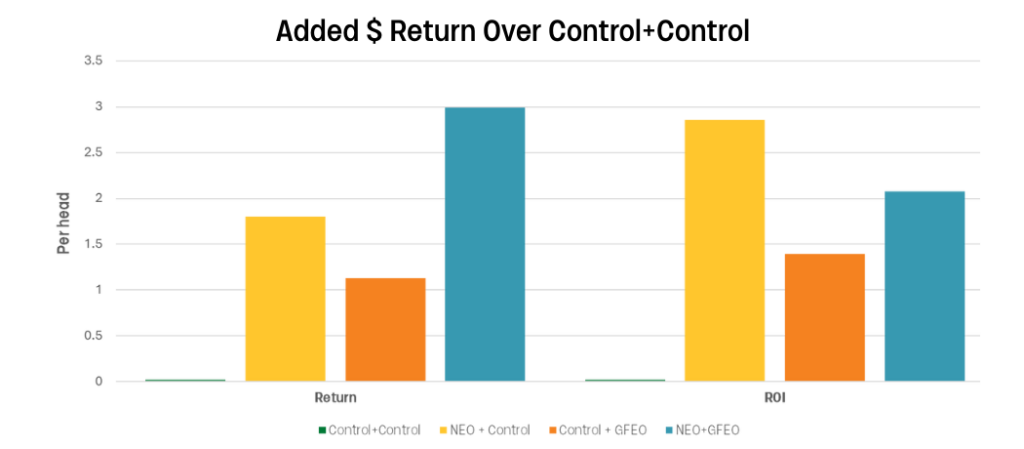
So, in this instance, if you only chase the highest ROI, you actually miss out on higher return and more money in your pocket. That same principle applies to the research results shown in Figure 1. The full-lifetime essential oil program delivered the most total return, even though the nursery-only treatment showed a higher ROI.
Figure 1. Dollar Return and ROI per pig from essential oil administration during differing combinations of growth phases.
What this Study Really Means for Producers
This research answered the question producers have asked for years: “Should essential oils be used in the nursery or the finisher to get the biggest performance boost?” The data says you should consider both.
While each stage delivers value on its own, stacking nursery and finisher essential oil technologies creates a bigger, additive response.
And here’s what makes these results even more meaningful: They occurred in a barn without a health challenge.
Bottom line, not all essential oils are the same, and they certainly aren’t simple fragrances. When Microfused (stabilized) and formulated for swine biology, they can play a powerful role in supporting gut health, immunity and performance across all phases of production.
This new research shows a clear path forward. Administration in the nursery lays the foundation. Administration in the finisher builds on it. Together, they help pigs reach a higher level of performance that translates directly into profitability.
Want to add essential oils in your nursery and finisher programs, or run a field demo in your system? Sign-up to get started with a free trial of Essential-Lyte today!
Let us evaluate your system and identify where essential oils can drive the most dollars and gain.