

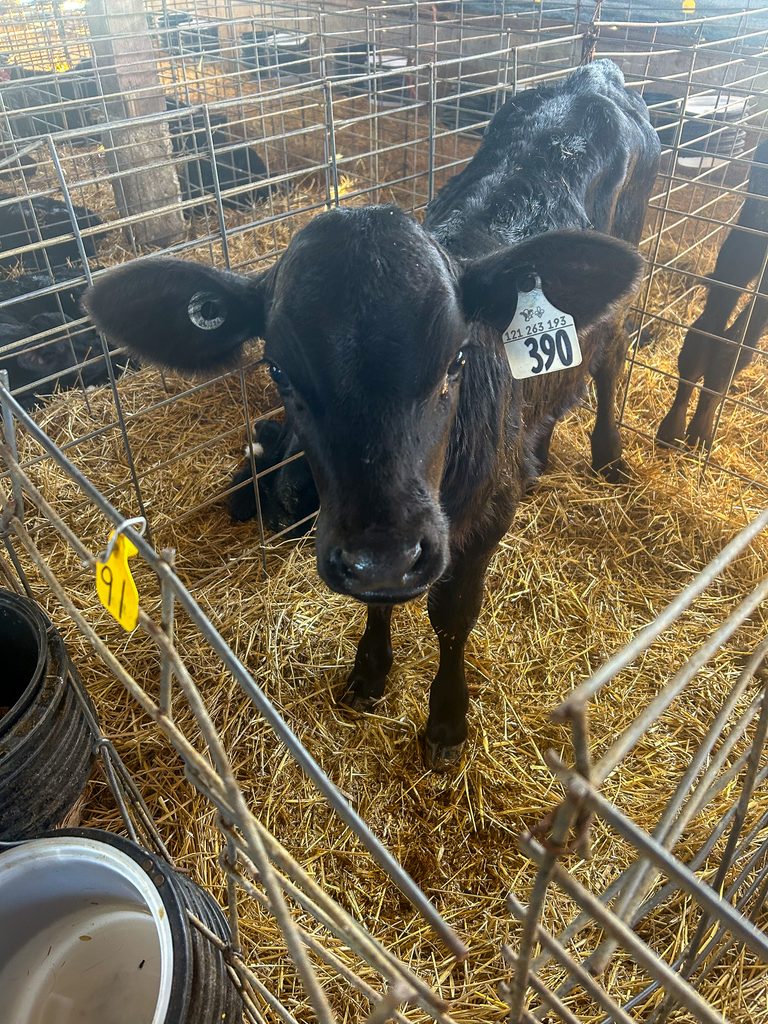
Every dairy is working with the same beef prices right now. But ask three dairy producers how that’s changing their calf programs and you’ll get three different answers on breed, three different vaccination protocols and three completely different philosophies on what makes a calf worth buying. The one thing they don’t disagree on is what actually determines whether a calf thrives: colostrum, navel care and daily health screenings. Get those right, and breed stops being the variable that matters.
Where They Split: Breed Strategy
The disagreement starts at the most basic question, “Holstein or beef cross calves?” and never really resolves.
A North Indiana producer runs 95% Holsteins and has for 20 years, and on a per-head basis still finds them more profitable once fats are finished and penciled out. Part of his hesitation on crosses comes down to consistency. “There are a lot of cross cattle that pull more dairy characteristics and don’t provide the full beef pull through.” Meaning, a calf labeled as a beef cross doesn’t always carry the muscling or frame that label implies. Some perform more like a straight dairy calf despite the premium price tag.
A Wisconsin producer running a 600-head dairy sees it almost the opposite way. “Beef calves all day,” he said. “They’re way more aggressive, drink better and get up and on their feet almost instantly. Much heartier animal as soon as they’re born.” He only keeps beef calves 4 to 5 days before selling. At $1,300 to $1,500 a head, it’s money he can’t leave on the table. “Can’t afford not to raise beef calves right now,” he said. “Can’t pass up what’s being offered.” That preference drives his whole breeding program: he ranks the herd on net merit using parent averages, works backward from a target number of replacement heifers (say, 30 a month) and breeds only that many cows to Holstein semen, and sends everything else to beef bulls. In his words, “A Holstein bull calf is the worst thing to be born.” There’s no market pull, no replacement value.
A South Indiana producer thinks breed is the wrong question entirely. “I think there are equally good Holstein calves and beef/dairy crosses and equally bad Holstein calves and beef/dairy crosses,” he said. “If you screen all of your calves together, you can have just as good luck and uniformity with Holsteins as you do with beef crosses.”
The split holds even outside the Holstein-versus-cross debate. The North Indiana producer ranks other dairy breeds by how hard they are to finish. Montbeliarde is the best, but hard to source, and Jerseys are hard to finish and poor on yield grade. The South Indiana producer has raised Jerseys, Brown Swiss, Holsteins and Guernseys, and lands on a similar tradeoff from the other direction. Jerseys and Guernseys never reach Holstein or beef-cross weight and growth, but they cost less to buy in, which factors into the bottom line either way.
So, if you’re looking for a consensus answer on breed strategy, there isn’t one, and that’s the point. The right call depends on your facility, your labor, your market access and what you’re set up to execute well. What does carry over from one operation to the next is everything that happens after the breed decision is made.
Where They Agree: The Protocol That Doesn’t Change
Here’s what’s notable. Despite picking apart breed from every angle, none of the three producers actually handle Holsteins and beef crosses differently once the calf is in the barn. “It’s the same process start to finish regardless of the breed,” the North Indiana producer said. “I don’t handle them differently,” the South Indiana producer echoed. “They’re handled the same way.”
That shared process comes down to three things, named independently by all three:
1. Colostrum
The Wisconsin producer’s protocol starts within the hour: “Gallon of high-quality colostrum, dip the navel and get them in a dry pen by themselves.” He singles out feeding real cow colostrum instead of a replacer as the single best change he’s made for calf health and performance. The South Indiana producer runs the same priority. “Upon arrival, give them colostrum and check the navels and get them started on a good vaccination program. Management plays a huge role in this stage, and we’re the ones responsible for getting the calves off to a great start.”
2. Navels
All three named this step specifically as something they check right away. Infection at the navel is an early sign of how that calf is likely to perform, regardless of what breed it is.
3. Health Screening
“You must keep on top of the calves’ health,” the South Indiana producer said. “That means you walk calves every day looking for any changes in them, and if you find issues you start treatment right away, either individually or as a group depending on what you’re seeing.” A few coughing or scouring calves get treated individually, but if a quarter or more of the group shows symptoms, the whole group gets treated. The North Indiana producer pushes that same discipline but further upstream into purchasing. “I’m picky with what I will even buy or take a risk on, and I sort very hard for high-quality animals.”
One Place Breed Changes the Plan
Vaccination protocol is the exception, and the one spot where breed genuinely changes what a producer does. At the Wisconsin dairy, “All calves receive newborn protocol, but then only Holstein heifers receive vaccines for respiratory, E. coli and Salmonella.” Beef calves are gone from the operation in days, well before those vaccines would matter. The other two Indiana producers run the identical health program across every calf, regardless of breed or end use. Even here, the logic is the same for all three. The vaccination plan follows how long the calf will actually be on the operation, not what breed it is.
What’s Outside Their Control
If there’s a frustration shared across all three conversations, it’s that so much of a calf’s outcome is decided before it ever arrives. “If we could control when, where and how we get the calves to our facilities,” the South Indiana producer said, describing his one wish for the industry, “we’d know they were coming from good startup programs, already getting the colostrum and shots they need before they ever reach us. But that part’s out of our hands, so it just means staying extra vigilant on our end.”
The Wisconsin producer put the job itself more simply. “Everybody would raise calves if it was easy. I like the challenge of getting calves off to a good, healthy start.”
Bottom line, breed strategy is a real decision, but it’s not a decision with a right or wrong answer. It depends on your operation, your market and what you’re set up to execute well. What isn’t optional, no matter which side of the beef-price swing your calves land on, is the fundamentals. Fast, high-quality colostrum, a close eye on the navel and health screening every single day. That’s the program that determines whether a calf thrives, and it’s the same program whether that calf is a Holstein heifer destined for the milking barn or a beef cross gone in five days.
How Ralco Can Help Your Calf Program, Naturally
Whatever breed strategy fits your operation, every calf faces the same pressure points in those first critical days, colostrum intake, navel health and immune challenges. Ralco’s calf program is built to naturally support calves through each transition, using patented technologies backed by peer-reviewed research.