
• Skip to main content
  • Skip to header right navigation
  • Skip to site footer
  • Careers
  • Contact Us
Logo for Ralco featuring a stylized green letter "R" with a leaf inside a yellow circle, next to the text "RALCO Nature Elevated by Science" in green letters.

Ralco Agriculture

  • Home
  • About
    • History
    • News
    • Sustainability
  • Our Science
    • Microfused® Essential Oils
    • Actifibe®
    • Microbial Catalyst®
  • Products
        • All Products
        • Swine
          • Nursery / Grow-Finish Health
          • Gestation / Lactation Health
          • Nursery Nutrition
          • Grow-Finish Nutrition
          • Specific Health Challenges
        • Poultry
        • Beef
          • Cow/Calf Health
          • Cow/Calf Nutrition
          • Feedlot Health
          • Feedlot Nutrition
        • Dairy
          • Calf
          • Cow
        • Crops & Forage
          • Crops
          • Forage
        • More Solutions
          • Aquaculture
          • Equine
          • Feed Mill
          • Organic
          • Show Animals
          • Small Ruminants
  • Resources
    • FAQs
    • Videos
    • Podcast
    • Ralco Reader Blog
  • Shop
  • Careers
  • Contact Us
Search Search
Search
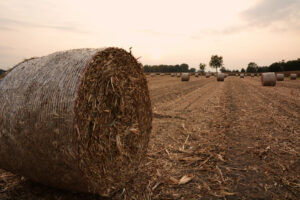
A large round hay bale sits in a harvested field at sunset, with several other hay bales scattered in the distance, under a partly cloudy sky.

5 Tips for High-Quality Corn Stalk Bales

August 17, 2022 | Beef

With fall and winter right around the corner, farmers and ranchers might look at their hay supply and hope it lasts. With the drought, hay shortages and high prices – every forage will be stretched to the max, including corn stalks.

Most cattlemen only use corn stalks for bedding because they don’t feed well. Cattle will sort corn stalk bales for leaves and husks and waste the stalks. To help minimize waste and use low-cost corn stalks for feed, here are 5 tips to put up high-quality bales your cows will actually eat.

5 Tips for High-Quality Corn Stalk Bales:

  1. Use a flail stalk chopper or grind bales before feeding to make smaller pieces that cattle won’t sort out when bales are fed.

  2. Avoid raking windrows together in the early morning or late evening when dew is present. Excess moisture will lead to more spoilage and less palatability.

  3. Don’t rake more than you can bale. Once a windrow gets wet, it is hard to dry down.

  4. Stack corn stalk bales in a space protected from the elements such as a hay shed. Corn stalk bales are porous and don’t shed moisture like hay bales.

  5. If stacking bales outside, place bales in a single row on a gentle slope. Preferably facing north and south to provide equal sunlight for drying. If stacking bales in a pyramid, use a tarp to protect them from precipitation.

How One Central Minnesota Farmer Feeds Corn Stalks

Farmers and ranchers in central Minnesota were hit hard by drought in 2021. But a farmer from Gonvick found success feeding high moisture corn stalk bales to his cows in early August using Anchor™ for Hay.

“Typically, our corn stalk bales are just for winter bedding and don’t look good enough to feed. These bales looked great even after carrying them over from last fall. We treated them with Anchor at 30% moisture without much faith that it would work.

Due to this year’s drought, the pasture grass ran out in August, so we started supplementing with corn stalks. We put them into a total mixed ration (TMR) mixer with some dried distiller grains (DDGs) and fed them in the pasture so our cows would have something to eat. I was shocked when 80% of the corn stalks were cleaned up! The cows are looking great, and we can keep our limited hay supply for the winter months.”

How to Reduce Moisture & Spoilage in Corn Stalk Bales

High-moisture corn stalks can be a challenge to dry down, often resulting in spoiled bales that don’t break apart well. Anchor can help.

Anchor is a dry granular product that helps preserve higher moisture corn stalks by reducing heating and spoilage, resulting in:

  • Easy to grind and pull apart bales

  • Bales with less sagging

  • Higher quality feed and bedding

  • A palatable “brown sugar” smell

Try Anchor today and save up to $500 on hay preservative applicators!

Share this post

Sidebar

Categories

  • News
  • Beef
  • Dairy
  • Poultry
  • Swine

Archives

  • July 2026
  • June 2026
  • May 2026
  • February 2026
  • January 2026
  • December 2025
  • November 2025
  • October 2025
  • September 2025
  • August 2025
  • July 2025
  • June 2025
  • May 2025
  • April 2025
  • March 2025
  • February 2025
  • January 2025
  • December 2024
  • November 2024
  • October 2024
  • August 2024
  • June 2024
  • May 2024
  • March 2024
  • February 2024
  • January 2024
  • December 2023
  • September 2023
  • August 2023
  • July 2023
  • June 2023
  • March 2023
  • February 2023
  • January 2023
  • December 2022
  • November 2022
  • October 2022
  • August 2022
  • July 2022
  • June 2022
  • May 2022
  • April 2022
  • March 2022
  • February 2022
  • December 2021
  • August 2021
  • July 2021
  • June 2021
  • April 2021
  • March 2021
  • January 2021
  • December 2020
  • October 2020
  • August 2020
  • July 2020
  • June 2020
  • May 2020
  • April 2020
  • March 2020
  • February 2020
  • December 2019
  • October 2019
  • July 2019
  • June 2019
  • May 2019
  • April 2019
  • February 2019
  • June 2018
  • March 2018
  • February 2018
  • December 2017
  • August 2017
  • May 2017
  • March 2017
  • December 2016
  • November 2016
  • October 2016
  • August 2016
  • July 2016
  • June 2016
  • January 2016
  • December 2015

Categories

  • News
  • Beef
  • Dairy
  • Poultry
  • Swine

Let’s Tackle Your Toughest Challenge

If there’s a problem holding your operation back, we’re here to help you solve it. If you’re ready for products that bring together nature and science, let’s talk!

Ralco News

Holstein dairy calf in a fenced in hutch

Heat Stress in Dairy Calves Starts Before You See It

Heat stress is usually talked about in terms of the milking herd. Lower dry matter intake, reduced …
Read moreHeat Stress in Dairy Calves Starts Before You See It
Two white broiler chickens stand close to a water dispenser; one chicken drinks from a red nozzle above, while the other looks on with its beak slightly open. The background shows more chickens out of focus.

How to Use Poultry Production Data to Make Better Flock Decisions

Production data is one of the most powerful tools in commercial poultry operations, but the biggest …
Read moreHow to Use Poultry Production Data to Make Better Flock Decisions
A group of black and white dairy cows stand in a circular milking parlor, attached to milking machines, inside a bright, modern barn.

Mastitis in Dairy Cows and Heifers: How to Manage Risk Before Production Loss

Mastitis remains one of the most costly and complex diseases in dairy production. The National …
Read moreMastitis in Dairy Cows and Heifers: How to Manage Risk Before Production Loss
Ralco logo with a green vertical bar and a leaf inside a yellow circle, next to the word "RALCO" in white, and the tagline "Nature Elevated by Science" below.
Four faded certification logos in a row, including HALAL, RMPP, GMP+, and FAMIQS, on a light background. Text and images within the seals are barely visible.

Subscribe for news and updates

Home
About
Our Science
Shop
Resources
Careers
Contact Us
Call 1 (800) 533-5306

  • Facebook
  • Instagram
  • YouTube
  • LinkedIn

Copyright © 2026 · Ralco Agriculture · All Rights Reserved · Privacy Policy

We use cookies to enhance your browsing experience, serve personalized ads or content, and analyze our traffic. By accepting, you agree to our use of such cookies. Privacy Policy