
Backgrounding works. That much has been well established over the years. What’s harder to find is real proof of what it’s actually worth in dollars, and what a good nutritional program can do for calves during the roughest stretch of that process.
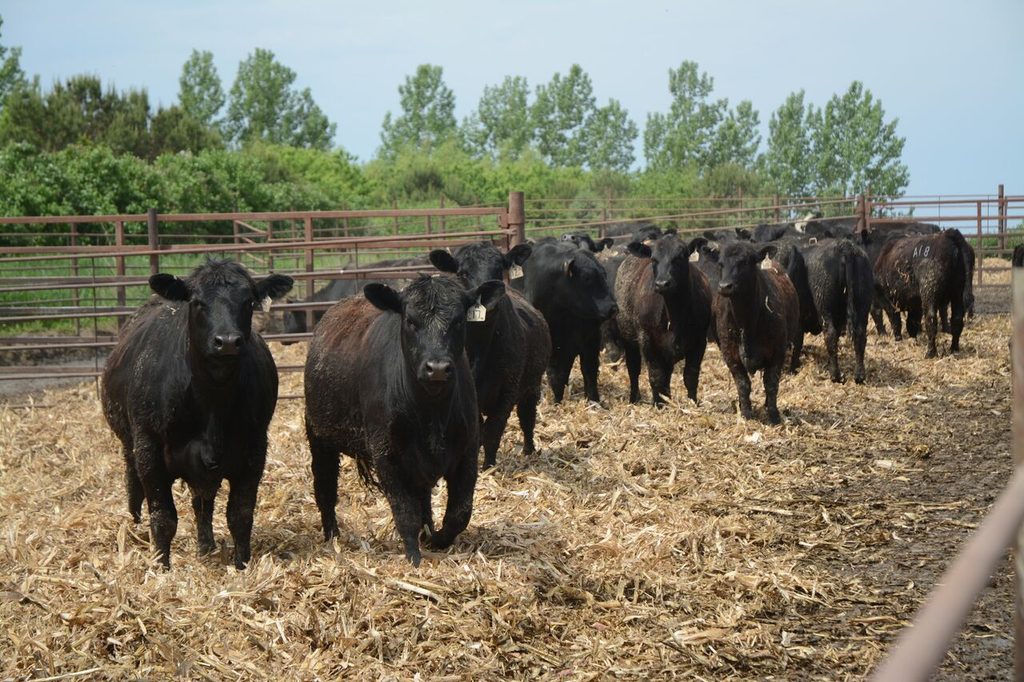
In mid to late November one year, trucks started pulling into M&E Cattle Company in Floresville, Texas, unloading calves bought at sale barns across the region. M&E is a backgrounding lot, an operation that buys young calves, feeds them for two to three months and sells them once they’ve put on weight and gotten past the weaning transition.
That fall, 531 head arrived in three separate waves, and none of them had come from the same place. What they did have in common though was stress.
The First Three Weeks Are Crucial
That stress was immediately evident. There’s a reason cattlemen talk about the first 14 to 21 days after a calf changes hands. Whether the change is weaning, a sale barn trip or a truck ride to a new yard, that window determines most of what happens over the next 100 days, and it has almost nothing to do with growth. It’s a health story. The rumen and gut are adjusting, the immune system is under pressure and respiratory disease, both viral and bacterial, is looking for an opening to strike. (1, 2)
M&E found out exactly how true that was. Every single death that occurred across all three groups in this Ralco field study happened inside that three-week window. Most likely, calves were exposed at the sale barn or were carrying disease upon arrival to the M&E yard. M&E didn’t create that risk. They inherited it and had three weeks to do something about it.
Why Backgrounding Matters
A rancher who’s watched a set of calves come apart after a sale barn purchase knows exactly what M&E was up against, and it’s exactly why some producers choose to hold calves back and precondition them before they’re ever sold. Part of it’s timing the market, since calf prices swing, holding a set of calves can mean selling into a stronger price a few weeks or months later (3).
Part of it’s also physical. A freshly weaned calf spends the first several days pacing the fence and bawling for a cow that isn’t around, and energy spent stressing is energy not spent on growth. Give that same calf 60 days on the ranch, and with the right nutrition and health program, it can overcome health challenges and keep gaining weight.
Breaking Down the Research
That 60-day number isn’t random, and it’s worth digging into where it comes from and what shapes it. Calves lose weight after weaning. That’s not a management failure, it’s a predictable physiological response to stress, and research on the topic consistently points to two things that determine how fast that weight comes back.
The first is weaning strategy. Fenceline weaning, two-step weaning and abrupt separation all produce different stress responses in calves, and research shows gentler transitions tend to shorten the dip in intake and gain that follows. (4)
The second is nutrition. Calves offered a properly balanced, palatable ration (typically high-quality hay paired with a small, gradually increasing amounts of grain or starter feed) in the weeks right after weaning start eating sooner and regain lost weight faster than calves left on a lower quality or inconsistent diet. (5, 6, 7)
Together, these two factors, weaning method and nutrition, explain why some calves recover within a couple of weeks while others are still behind at day 60, even if weaned on the same day.
However, drought adds another variable to the equation. When pastures dry up, producers may choose to wean early to ensure adequate body condition of the cow, since a thin, stressed cow going into winter is a bigger long-term problem than a lighter calf at weaning. (8, 9) The tradeoff of not weaning early during drought is the calf comes off the cow lighter than in a normal year.
Counterintuitively, research shows early weaned calves catch up and even finish heavier than herd mates left on declining, drought-stressed pastures. Early weaned calves have access to more energy-dense feedstuffs sooner than their counterparts. (8, 9) Across the research, guidance for drought-stressed calves headed to a feedyard is consistent. Plan for 60 days of backgrounding at minimum. (10, 11, 12, 13, 14) Fewer days and you’re selling a calf that’s recovered from the stress of weaning but hasn’t had time to convert that recovery into real, marketable gain.
That’s the peer-reviewed research picture. What happened at M&E is what it looks like put into practice.
Inside the Texas Field Trial
Each of the three arrival groups were split into two treatment groups: 1) control pen and 2) Ralco Stand Strong for Ruminants pen which received 2.5 grams per head per day of Stand Strong, a natural feed additive containing patented Microfused Essential Oils and Microbial Catalyst. Both treatments were offered the same roughage-heavy ration of free choice hay, cotton burs, wet brewers’ grain, rolled corn and Rumensin supplement.
| Group | Pen | In Weight (lbs.) | Out Weight (lbs.) | Days on Feed | ADG (lbs./day) | Feed to Gain (lbs.) | Cost of Gain ($/cwt) | Death Loss |
| Group 1 (200 head, lightest and youngest) | Control | 367 | 619 | 107 | 2.36 | 4.7 | $113.18 | 18% |
| Group 1 (200 head, lightest and youngest) | Stand Strong | 355 | 613 | 108 | 2.4 | 4.48 | $109.32 | 17% |
| Group 2 (199 head) | Control | 530 | 724 | 97 | 1.99 | 7.27 | $170.78 | 12% |
| Group 2 (199 head) | Stand Strong | 542 | 758 | 97 | 2.23 | 6.14 | $141.63 | 6.06% |
| Group 3 (132 head, heaviest at arrival) | Control | 705 | 840 | 84 | 1.61 | 10.75 | $239.51 | 4.55% |
| Group 3 (132 head, heaviest at arrival) | Stand Strong | 697 | 862 | 83 | 1.99 | 8.43 | $193.17 | 6.06% |
Evaluating the three arrival groups side by side and the pattern is straightforward. Stand Strong’s advantage over control grew as the calves got heavier with less morbidity and improved feed efficiency and less cost of gain.
What the Economics Say
Feed efficiency can be more beneficial than evaluating average daily gain alone. This M&E trial is evidence to that since the only thing different between the two pens was the addition of Stand Strong.
| Feed to Gain (lbs.) | Cost of Gain ($/cwt) | |
| Typical backgrounding baseline | 7 to 11 | $170 to $240 |
| M&E trial, control pens | 4.7 to 10.75 | $113 to $240 |
| M&E trial, Stand Strong pens | 4.48 to 8.43 | $109 to $193 |
Even a few tenths of a pound of improved feed efficiency adds up over an 80-to-110-day backgrounding period. That combined with extra pounds gained, it’s what turns into real money per head.
This trial saw $11 per head in feed savings, $19 per head in added value from extra gain, which added up to a $30 per head increase for Stand Strong calves over control calves. Addition of Stand Strong to the diet cost $3.25 cents per head per day, which was a return of 9 to 1.
What Drove That Return
That $30 per head advantage wasn’t a surprise. Stand Strong uses two patented Ralco technologies that work together to help overcome challenges such as those seen in this trial.
Microbial Catalyst works inside the rumen. On a roughage heavy diet like the one fed at M&E, fiber is locked up in tough plant cell walls that native rumen microbes can only break down so fast on their own. Microbial Catalyst boosts that microbial activity, unlocking more energy from the same feed, roughly the equivalent of an extra pound of corn per head per day without adding more corn.
Microfused Essential Oils support immune function and the body’s response to stress. Of course, it is preferred to have calves consuming Microfused Essential Oils prior to a stressful event is one approach that may help support calves during that time.
For calves that arrive already showing signs of stress or high-risk calves, Fight Strong Pellet is built for that level of challenge. Fight Strong combines a third Ralco technology, Actifibe Prebiotic, with Microfused Essential Oils and Microbial Catalyst, a combination intended to support appetite and rumen function during periods of stress. It’s typically fed for around 28 days during the toughest stretch after arrival. Where Stand Strong is designed as a daily program for calves working through normal backgrounding stress, Fight Strong is built for calves facing a tougher transition.
Bottom line, none of this changes the basics. The first three weeks still decide most of what happens over the next hundred days, and a calf that arrives already compromised has a tougher road ahead.
What the M&E trial shows is the right nutrition and health programs can move the needle inside that reality, turning a rough set of sale barn calves into a $30 per head advantage, 9 to 1 return, even in a year when death loss ran high and nothing about the calves made it easy. It’s proof that backgrounding, done well, pays.
Questions about building a backgrounding program? Contact the Ralco beef team at 1-800-533-5306.
References
- Werid, G.M., Batterham, T., Kebede, H.K., Aleri, J., Hemmatzadeh, F., Pitchford, W.S., Trott, D.J., Petrovski, K. “Determinants of mortality from bovine respiratory disease in Australian feedlot cattle: A survival analysis.” Preventive Veterinary Medicine (2026).
- Washington State University College of Veterinary Medicine. “Bovine Respiratory Disease (BRD) in Dairy Calves and Cattle.”
- Silverchair. Market timing and cattle price cyclicality research.
- PMC / Journal of Animal Science. Weaning strategy and calf recovery research abstract.
- University of Wisconsin Madison Extension. “The Importance of Beef Calves Preconditioning Nutrition.”
- University of Wisconsin Ag News. “Preparing for Weaning.”
- Iowa Beef Center. “Preconditioning Calves.”
- North Dakota State University Extension. “Early Weaning Beef Calves.”
- Silverchair. Early weaning and body condition score research.
- South Dakota State University Extension. “Managing Light Weight Calves.”
- South Dakota State University Extension. “Combatting Drought Conditions, Early Weaning.”
- University of Nebraska Lincoln Beef. “Early Weaning Strategies for Challenging Forage Conditions.”
- Iowa Beef Center. “Early Weaning Drought.”
- South Dakota State University Extension. “Resources, Early Weaning Beef Calves.”