

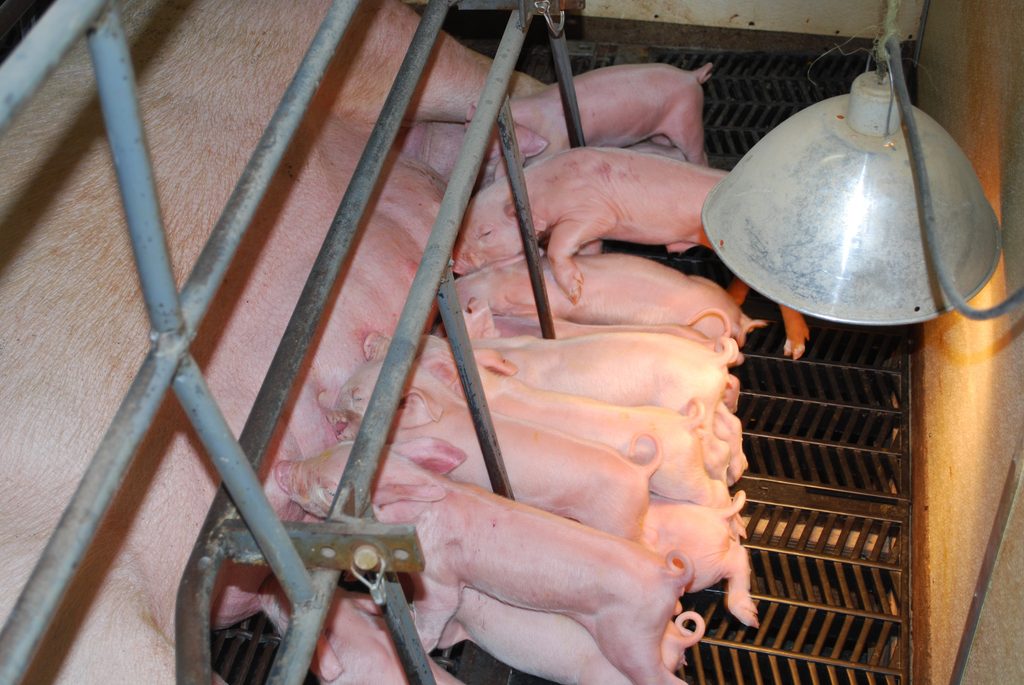
Two decades of genetic and management progress have dramatically increased what the modern sow can produce, but not without tradeoffs. New pressure points have shown up across the system, largely because gains in total pigs born have outpaced what the sow and her farrowing house environment can keep up with. That gap is where today’s biggest opportunities for improvement are hiding.
Modern Sow is Highly Prolific
The numbers tell the story clearly. According to 2025 year-end PigChamp benchmarking data across 149 U.S. sow farms, the average sow now farrows 16.21 total pigs born per litter, compared to 11.5 in 2004. (1) That’s a 41% increase in just over two decades. With a farm standard deviation of 1.45 pigs around that average, a meaningful number of individual sows are routinely farrowing more than 20 pigs in a litter. (1)
That’s a remarkable genetic and management achievement. It’s also a lot more pigs to manage per farrowing event than the system was originally built around.
Gap Keeps Widening
Here’s where the story gets more interesting. Benchmark trend data from 2004 to 2023 show that total pigs born per litter have been climbing faster than total pigs weaned per litter, a trend of roughly +0.23 pigs per litter per year for total born, versus +0.16 pigs per litter per year for total weaned. (2) Over 19 years of data, that’s 1.25 pigs of lost opportunity.
In other words, sows are having more total piglets born than ever, but a growing share of that genetic potential isn’t making it to weaning. Capitalizing on these reproductive gains that the industry has worked so hard to achieve is turning out to be its own challenge.
Bottlenecks
One of the clearest examples of this mismatch shows up in colostrum access. Colostrum is critical to piglet survival, but colostrum yield isn’t well correlated with litter size. (7) Furthermore, genetic progress for larger litter size has outpaced genetic progress for added functional teat count, and as a result, today’s piglets receive less colostrum individually than piglets born in the past. (3)
Due to the weak relationship between litter size and colostrum yield, the working assumption on most farms should be that more piglets doesn’t automatically mean more colostrum to go around. That leaves more piglets competing for access to a resource that’s critical to early survival.
One more pressure point shows up in the farrowing house itself, not just at the udder. Bigger litters mean more piglets to manage. Whether that’s through split suckling strategies, cross fostering decisions or heightened observance, labor availability hasn’t scaled alongside litter size. That gap puts even more pressure on early piglet care. The piglets who need the most help are often the ones who go longest without it when labor is stretched thin.
Hidden Cost to the Sow
It’s also not just the piglets feeling the strain. The sow is under more physiological and oxidative stress than she was 25 years ago, simply because there’s more happening inside her leading up to and during farrowing.
Farrowing 40% more piglets requires more time to deliver them, and longer farrowing durations come with a real downstream risk. Extended farrowing time has an energy cost for the sow and the piglets still waiting to be born.
If a sow tires during an extended parturition, she may not be able to successfully push out her piglets on her own. Assisted farrowings have been linked to increased prolapse incidence (6), and the longer a piglet waits its turn in a prolonged farrowing, the greater its risk of oxygen deprivation (hypoxia) and low vigor at birth. Meaning, some of these piglets start out behind before they even hit the mat.
Longer, more difficult farrowings also increase labor and management demands at exactly the point when closer observation and timely intervention matter most.
Rethinking a One-Size-Fits-All Gestation Diet
Most of the industry still feeds a single, static gestation diet from breeding to farrowing. That approach satisfied most farms when the sow’s litter size averaged 11 to 12 piglets born. It’s a practice worth revisiting for today’s sows who are carrying 16, 18 or 20+ piglets.
There are multiple reasons to believe why a sow’s nutrient demands are not static across the gestation period. Beyond a sow’s age (younger parity vs older parity), which will also contribute to her demands, she enters a window of rapid fetal growth after approximately day 60. She also experiences peak fetal mineral accretion and expanded maternal blood volume. In addition, mammary development begins to occur in preparation for colostrum and milk production. All this is happening at once, and all pulling from the same nutrient pool. (5)
A static diet formulated to an average requirement across all of gestation by definition underfeeds her during that late gestational window, when the payoff (her body condition, mammary development, colostrum quality and litter weaning weight) is at its highest.
How to Close the Weaning Gap
The goal isn’t simply weaning more pigs. It’s weaning more quality pigs, a higher number of heavier, more viable weaned pigs, and fewer light, disadvantaged ones that struggle to catch up in the nursery and beyond.
Genetic advancements are closing part of that gap. Natural, research-backed tools are helping to close the rest, an area Ralco has spent over 50 years building its work around. Here are a few short-term and long-term strategies that can help:
- Short-term strategies
Focus on giving disadvantaged piglets and stressed litters a stronger start. Ralco’s SOS and First Pulse D oral drenches, along with the Birthright products of milk replacers and starter pellets, help support the litter and a broader herd health program alongside good management practices in the farrowing house.
- Long-term strategies
Look at supporting the sow and litter across the full reproductive cycle: - Phase-appropriate nutrition. A nutrition program like EnMAX, built around the differing nutritional demands of gestation and lactation rather than single static diets.
- Antioxidant support for stress. Products like ProsperEO are formulated for the added oxidative load that comes with stressful situations.
- Gut health. Products like Regano EX and Dual Defender are formulated for supporting healthier larger litters.
- Automated supplemental milk systems using Birthright Milk. These deliver supplemental Birthright Milk to litters through movable cups. An asset that frees up the sow to take on more pigs from an over-farrowed situation.
Even one of these tools on its own can make a difference. But the biggest gains tend to come from a program built around your specific operation, matching the right combination of short- and long-term tools to where the pressure actually shows up. That’s exactly the kind of program Ralco can help you build.
Bottom line, genetics and allied industry isn’t the villain here. They did their job. The modern sow has never had more to give. The challenge is turning those advancements into pigs that make it to weaning at the level of quality that pays, which comes down to giving her and her litter the tools to thrive.
Questions? Give us a call at 1 (800) 533-5306 to talk to a swine specialist today!
References
- PigChamp. 2025 Year-End Benchmarking Summary, and Benchmark Magazine, 2024 (USA). https://www.pigchamp.com/flipbooks/benchmark-magazine/2024/USA/20/index.html
- PigChamp. Benchmark Magazine, 2024 (USA), 2004–2023 trend data. https://www.pigchamp.com/flipbooks/benchmark-magazine/2024/USA/20/index.html
- National Hog Farmer. “Does the Modern Sow Produce Enough Colostrum?” https://www.nationalhogfarmer.com/livestock-management/does-the-modern-sow-produce-enough-colostrum-
- National Hog Farmer. “The Modern Sow: How Genetics, Management Are Redefining Productivity.” https://www.nationalhogfarmer.com/livestock-management/the-modern-sow-how-genetics-management-are-redefining-productivity
- South Dakota State University, College of Agriculture, Food and Environmental Sciences. Genetic Progress and Increased Nutrient Demand in the Modern Sow (presentation materials).
- https://doi.org/10.1093/jas/skac064.191
- T. Feyera, J.C. Johannsen, P. Langendijk, D. Vodolazska Review: Colostrum production and intake- functional roles in piglet survival, future reproduction, and the challenge of genetic selection. Animal The internation journal of animal biosciences, Volume 20, Supplement 1, 2026. https://doi.org/10.1016/j.animal.2026.101773.