
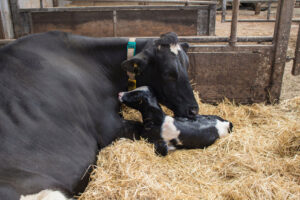
Colostrum timing, immune development and early nutrition all play critical roles in calf health and performance. Here’s what you need to know, and do, in the first 48 hours to raise stronger, healthier dairy calves.
Timing and Quality Matter More Than You Think
Newborn calves enter the world with a huge disadvantage: they have no circulating antibodies to fight off disease. This condition, called agammaglobulinemia, is due to the structure of the bovine placenta (a cotyledonary synepitheliochorial placenta), which completely blocks the transfer of maternal antibodies during pregnancy. (1)
In humans, the placenta (hemochorial type) allows direct transfer of maternal immunoglobulin G (IgG) across the placenta in the last trimester. As a result, babies are born with a fully primed immune system, carrying many of the same antibodies as their mothers, and can mount immune responses much earlier.
In contrast, calves are born essentially immunologically bare. Their only chance to acquire disease-fighting antibodies is by ingesting high-quality colostrum within the first few hours of life. That’s why colostrum isn’t just “first milk,” it’s an emergency dose of immunity, nutrition and gut protection. If delayed or inadequately provided, the opportunity for passive immunity begins to decrease 6-12 hours after birth and ends at 48 hours, leaving calves dangerously exposed to infectious diseases and a weakened immune system.
Tips for feeding colostrum to calves:
Feed 4 quarts (or 8–10% of birth weight) of high-quality colostrum within the first 1–2 hours of life.
Follow with a second feeding 12–18 hours later.
Aim for a colostrum Brix refractometer reading >22%, which correlates to an IgG concentration >50 g/L. (2)
Don’t skip this for bull calves. All calves need equal care in these first hours of life.
A Brix refractometer is a simple handheld tool originally used to measure sugar content in liquids, but it’s also a reliable on-farm method to estimate colostrum quality and successful passive transfer of immunity in calves. In the case of colostrum, higher Brix readings indicate higher concentrations of immunoglobulins, particularly IgG.
To measure, place a few drops of clean, well-mixed colostrum on the refractometer lens, close the cover and look through the eyepiece toward a light source. A reading above 22% generally indicates high-quality colostrum with an IgG concentration greater than 50 g/L, which is ideal for successful passive immunity transfer. (6) To ensure that passive transfer of immunity was successful to the calf, a few drops of serum may be placed on the refractometer lens with the same instructions mentioned above. Serum IgG levels for calves include excellent (≥25.0 g/L), good (18.0–24.9 g/L), fair (10.0–17.9) and poor (<10 g/L). (2)
During this short colostrum window, calves also have a temporarily permeable gut epithelium (inner lining or “skin” of the digestive tract) designed to absorb large molecules like immunoglobulins. But this also allows pathogens to enter the bloodstream if the colostrum, or environment, is contaminated. (1) A sterile gut and immature immune system make them highly vulnerable in the first 48 hours.
This is where Start Strong for Calves can help. This natural oral drench delivers bioactive compounds from colostrum as well as Microfused Essential Oils, Actifibe Prebiotic, vitamin E and quick energy to stimulate appetite, reduce inflammation and support immune and digestive development right when calves need it most.
Calves Need Help Bridging Their Immune Gap
Even if a calf receives excellent colostrum, true immune independence takes time. While the innate immune system is partially functional at birth, it drops to 20% of adult capacity within 24 hours and takes 5 months to fully mature. (3)
Table 1: Estimated Timeline of Immune Development in a Calf
| Immune Component |
Begins Functioning |
Significance |
|
IgM (first antibody) |
~Day 4, circulating at Day ~8 |
Neutralizes new pathogens, but only mildly. Full function at ~Day 8. (4) |
|
IgA, IgG (mucosal/systemic) |
~Day 16-32 |
Provide protection to mucosal membranes. Low levels early in life leave calves more vulnerable to disease. (4) |
|
B cells (adaptive immune) |
Reach adult levels at ~8 wks |
Create specific antibodies to pathogens. Immature in early life. (3) |
|
Neutrophils |
~1 week |
Reach partial function (~20% of adult levels) at 6–8 weeks. Produce specific antibodies, immature early in life. (3) |
Because calves are so immunologically fragile, early-life stressors like transportation, environmental changes or commingling, can wreak havoc. Passive immunity from colostrum is their only real line of defense in those first weeks of life.
Stand Strong for Dairy Calves helps bridge this gap. It combines Microfused Essential Oils, Actifibe Prebiotic, probiotics, vitamins and selenium in a natural milk additive that supports immune development and digestive health while encouraging intake, especially crucial during times of transition and stress.
So Where Do Vaccines Fit in?
While vaccination is a critical tool for long-term health, it’s important to understand that most calves aren’t ready to mount a strong immune response right away. Maternal antibodies from colostrum can interfere with vaccine efficacy, and the calf’s own immune system is still gearing up.
For this reason, most vaccines don’t become fully effective until 2 to 4 months of age, once maternal antibodies wane and adaptive immunity matures. See Table 2 below for a breakdown of common pathogens and when calves are typically able to respond.
Colostrum is More Than Just Immunity
Yes, colostrum delivers antibodies. But its role is much more extensive:
It shapes the calf’s gut microbiome.
It helps the intestine grow, specifically the villi, which are tiny finger-like structures that absorb nutrients. (5)
It supports protein production and overall gut development so calves can start digesting and absorbing nutrients efficiently.
But here’s the catch – the quality of colostrum matters. If it’s clean and low in bacteria, it supports the growth of beneficial microbes. If it’s contaminated, harmful bacteria can take hold instead, setting the calf up for digestive issues and weaker immune function down the road.
Rumen Development Depends on Starter Feed, Not Hay
Calves are essentially monogastric in their first few weeks of life. Meaning, they rely on just one stomach compartment, the abomasum. The abomasum is the “true” stomach in ruminants and is responsible for digesting milk using acid and enzymes, similar to how our stomach works.
At this stage, the rumen isn’t functional yet, so nearly all digestion happens in the abomasum until calves begin eating solid feed and their rumen starts to develop. But starter feed, not hay, is what triggers rumen development. Fermentation of carbohydrates in starter feed produces volatile fatty acids (VFAs), especially butyrate, which fuel papillae growth in the rumen lining. (5)
Rumen papillae are finger-like projections that absorb VFAs and nutrients. Without proper stimulation from starter feed, papillae remain underdeveloped, limiting nutrient absorption. This is the main reason to not feed large quantities hay early on. Instead, provide straw as bedding to slowly integrate into the diet and support rumen development.
Weaning should begin when calves:
Consume 1.5–2 lbs. of starter per day
Have doubled their birth weight
Show consistent fecal health
Always use a step-down weaning strategy. Abrupt weaning often results in decreased intake and growth setbacks.
Intensive Milk Programs Boost Health and Growth
Intensive feeding programs offer calves closer to 20% of their body weight in milk or milk replacer, double the traditional 10%. This higher level of nutrition gives calves the energy and nutrients they need to grow rapidly and develop strong foundations early in life.
Studies show that calves on intensive milk programs’ experience:
Faster weight gain and better body condition
Improved development of digestive and immune systems
Increased nutrient absorption and metabolic activity (5)
This approach mirrors what calves would naturally receive from their dams and has been linked to enhanced gut maturity, greater insulin response and a more robust immune system. It’s a more biologically appropriate way to support calves during their most vulnerable stage.
That said, more milk also means greater care must be taken during weaning. As milk intake decreases, calves need help transitioning to solid feed. Offering a quality starter early, providing access to straw to stimulate the gut and supporting digestion are all key.
That’s where Fight Strong Pellet comes in. Formulated with Microfused Essential Oils, Actifibe Prebiotic and yucca schidigera, it helps support gut health, immune development and appetite making the shift from milk to dry feed smoother and less stressful.
Bottom Line
The first 48 hours of a calf’s life lay the foundation for everything that follows, from immune strength to growth rates and long-term performance. Providing clean, high-quality colostrum on time is non-negotiable, but it’s just the beginning.
Supporting gut and immune development with targeted natural tools shown above, feeding the calf’s biological potential with intensive milk programs and managing a gradual, stress-reducing weaning transition all work together to build a stronger, more resilient animal. When you get these early steps right, you set up your operation for long-term success.
Table 2: Vaccine Timing in Colostrum-Fed Calves (3)
Pathogen | Delivery (IM, IN, SC) |
Formulation (MLV or inactivated) |
Youngest age to mount a protective response |
Epidemiologic consequence |
Disadvantages/problems |
|
BRSV |
IM, INa, SC |
MLV, inactivated |
IN-MLV, 2 wk, 3 wk, IM-inactivated 4–5 wk |
Important pathogen < 4 mo of age |
Highly susceptible to antibody interference |
|
BVDV |
IM, SC |
MLV, inactivated |
IM-adjuvanted MLV 5 wk, IM-MLV or inactivated 7 wk |
Important pathogen > 4 mo of age |
MLV immunosuppression |
|
BHV-1 (IBR) |
IM, IN, SC |
MLV, inactivated |
IN-MLV, 2 d |
Important pathogen >4 mo of age |
MLV immunosuppression, lifelong latency |
|
Clostridial spp |
SC |
inactivated, toxoid |
SC-inactivated, toxoid 170 d |
Important pathogen 0–9 mo |
Local reactions |
|
Mannheimia Pasteurella |
SC |
MLV, inactivated, toxoid |
inactivated-toxoid 6 wk |
Important pathogen 0–9 mo | |
|
Mycoplasma bovis |
SC |
inactivated |
ND |
Important pathogen 0–9 mo | |
|
Salmonellaspp |
SC, IM |
MLV, inactivated, subunit |
SC-MLV 2 wk |
Important pathogen 0–9 mo |
MLV immunosuppression |
|
Rotavirus, Coronavirus |
oral |
MLV |
Oral 1 d of age |
Important pathogen 5–21 d of age |
Highly susceptible to antibody interference |
Abbreviations: IBR, infectious bovine rhinotracheitis; IM, intramuscular; ND, not done; SC, subcutaneous.
aAvailable in Europe.
Questions about colostrum management? Give our dairy specialists a call at 507-337-6916 or email RuminantHelp@RalcoAgriculture.com

Stand Strong for Dairy Calves – Milk Additive
Stand Strong for Dairy Calves is a natural milk additive that supports appetite and eases the transition to a grain diet while helping immunity.

Start Strong for Calves – Maximize Colostrum Intake
Start Strong for Calves is a natural oral drench that supports appetite, digestive health and provides newborns with the energy they require.
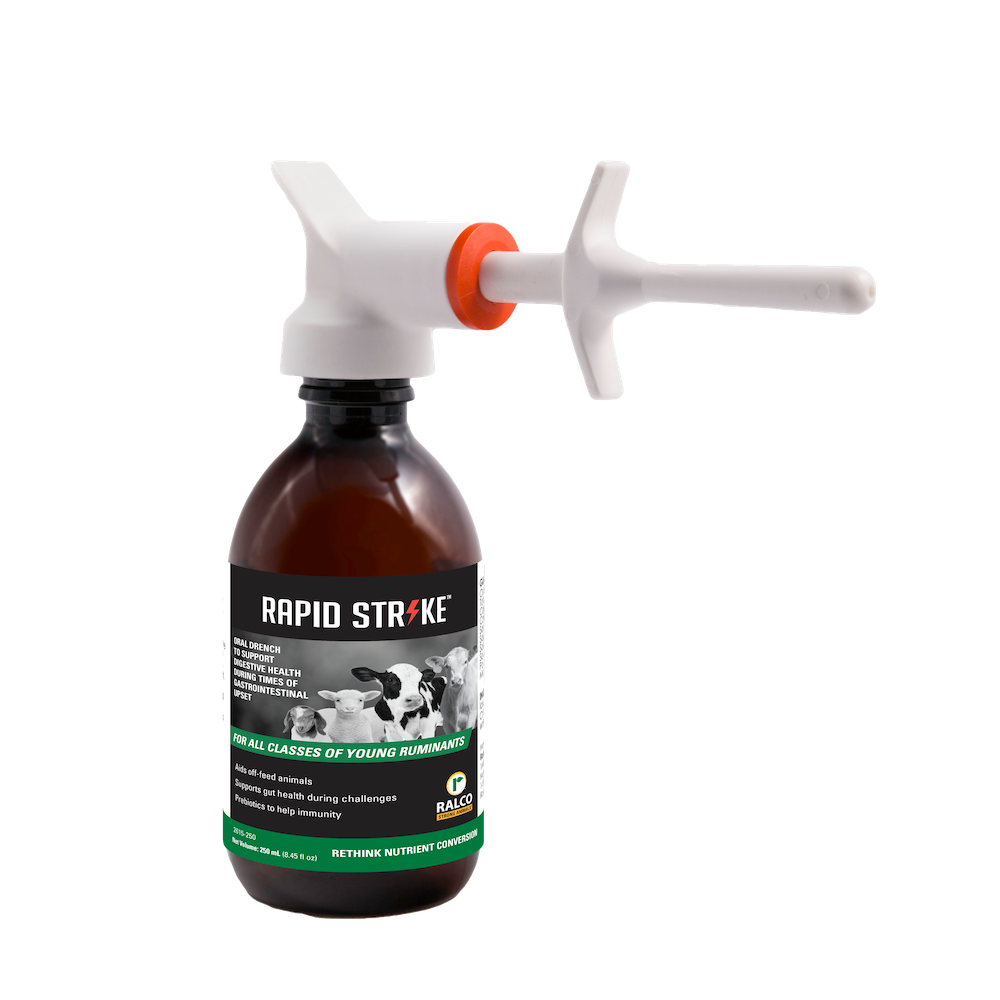
Rapid Strike – When Digestive Challenges Threaten
Rapid Strike is a natural oral drench that reduces pathogen load, enhances gut health and promotes a quick return to normal eating and drinking after digestive stress with scours.
References
Tizard, IR. (2024). Veterinary Immunology, 11th Edition. W B Saunders Co Ltd. ISBN: 9780443109751.
Lombard, J., Urie, N., Garry, F., Godden, S., Quigley, J., Earleywine, T., … & Sterner, K. (2020). Consensus recommendations on calf-and herd-level passive immunity in dairy calves in the United States. Journal of dairy science, 103(8), 7611-7624.
Chase, C. C., Hurley, D. J., & Reber, A. J. (2008). Neonatal immune development in the calf and its impact on vaccine response. Veterinary Clinics of North America: Food Animal Practice, 24(1), 87-104.
Abdallah, A., Francoz, D., Berman, J., Dufour, S., & Buczinski, S. (2022). Association between transfer of passive immunity and health disorders in multisource commingled dairy calves raised for veal or other purposes: Systematic review and meta-analysis. Journal of Dairy Science, 105(10), 8371-8386.
Hammon, H. M., Liermann, W., Frieten, D., & Koch, C. (2020). Importance of colostrum supply and milk feeding intensity on gastrointestinal and systemic development in calves. Animal, 14, s133-s143.
Penn State Extension. (2023, January 4). Colostrum management tools: Hydrometers and refractometers.