
• Skip to main content
  • Skip to header right navigation
  • Skip to site footer
  • Careers
  • Contact Us
Logo for Ralco featuring a stylized green letter "R" with a leaf inside a yellow circle, next to the text "RALCO Nature Elevated by Science" in green letters.

Ralco Agriculture

  • Home
  • About
    • History
    • News
    • Sustainability
  • Our Science
    • Microfused® Essential Oils
    • Actifibe®
    • Microbial Catalyst®
  • Products
        • All Products
        • Swine
          • Nursery / Grow-Finish Health
          • Gestation / Lactation Health
          • Nursery Nutrition
          • Grow-Finish Nutrition
          • Specific Health Challenges
        • Poultry
        • Beef
          • Cow/Calf Health
          • Cow/Calf Nutrition
          • Feedlot Health
          • Feedlot Nutrition
        • Dairy
          • Calf
          • Cow
        • Crops & Forage
          • Crops
          • Forage
        • More Solutions
          • Aquaculture
          • Equine
          • Feed Mill
          • Organic
          • Show Animals
          • Small Ruminants
  • Resources
    • FAQs
    • Videos
    • Podcast
    • Ralco Reader Blog
  • Shop
  • Careers
  • Contact Us
Search Search
Search
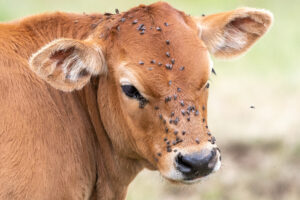
A close-up of a brown calf with many black flies clustered on its face and around its eyes. The background is blurred green and beige, highlighting the calf’s fur and the flies on its head.

How Garlic Can Help Minimize Pink Eye in Cattle

June 1, 2022 | Beef

Flies are enemy number one on most ranches, and with good reason. They spread diseases such as infectious bovine keratoconjunctivitis (IBK) or pink eye.

According to the University of Wisconsin, pink eye is primarily caused by the bacteria Moraxella bovis, which produces a toxin that attacks the eye. It is commonly understood that Moraxella bovis is the cause of traditional IBK or summer pink eye.

What is Pink Eye in Cattle, and What Causes it?

Pink eye is a highly contagious disease that impacts productivity and is incredibly painful to cattle. Several predisposing factors can cause it. Eyes have natural defense mechanisms against pathogens and infection, but once a scrape or abrasion occurs, the cornea can be exposed to bacteria such as Moraxella bovis.

Some predisposing factors to pink eye:

  • Face flies and house flies

  • Weeds, grass awns, seed heads, tall grass and stalks

  • Dust and sand

  • Other animals, overcrowded from heat stress and tails swishing from flies

  • Physical hazards, such as barbed wire or trauma during handling and transport

Pink Eye and Flies in Cattle

Traditional IBK is called summer pink eye for a reason. While IBK can happen at any time of the year, spikes more commonly occur in the summer as flies begin spreading it like wildfire.

Four primary types of flies impact cattle in the summer – horn flies, stable flies, house flies and face flies. The latter two are the ones most likely to spread pink eye.

According to University of Kentucky entomologists, face flies have sponge-like mouthparts that work by stimulating tear flow in cattle and sucking up the protein-rich secretions. They also feed on saliva, nasal discharge and blood from wounds. Face flies’ mouth parts have a sand paper like texture that irritates the eye and carry the disease from animal to animal.

Fly Control Methods for Cattle

The goal for fly control in cattle is to keep fly populations below the economic threshold, meaning, instead of 1,000-4,000 horn flies per cow, it’s suggested to keep flies below 200 per cow with fly control methods.

Various fly control programs exist today. However, with the head and eyes being a more sensitive area of the body, it is recommended to use fly control methods that can be close to the face without causing harm or self-applicators that cattle can use on their own.

Examples of these fly control methods include:

  • Dustbags that cattle pass under daily

  • Back rubbers with fly wicks

  • Self-applicator sprayers by mineral feeders

  • Ear tags

  • Garlic in mineral

Take note that fly resistance from chemical control methods can occur, meaning flies that survive these fly control methods go on to produce offspring that are also resistant to many of the commonly used sprays and chemicals. This is why beef producers must take a multifaceted approach to control flies and use more than one method at a time in the summer.

Garlic for Fly Control in Cattle

New research shows that feed additives such as garlic are helping cattle producers combat flies more effectively.

A Canadian research project in Saskatchewan found that adding garlic to mineral helped reduce the fly population by 50% in cow-calf herds. The research study used three cow-calf herds about two miles apart in different pastures. Two herds received a salt-mineral mix, and the other received garlic included in the mix. The cow-calf group eating the garlic had the lowest fly count.

However, buyer beware – not all garlic additives are the same. Doing your research before feeding just any garlic to your herd is essential. Some garlic additives have little to no research on their ability to repel flies and can be unpalatable to cattle. Always consult with a ruminant nutritionist or veterinarian before implementing.

Adding garlic to your mineral spring through fall and incorporating other fly control methods is recommended.

Ralco Mineral with Garlic Solutions

Ralco ruminant nutritionists have put the work into researching effective garlic solutions for farmers and ranchers. Ralco’s Rumatec™ Cow-Calf Mineralline-upnow includes Garlium options, a proven garlic additive that helps repel flies and ticks, to help beef producers effectively manage pests. As animals ingest this highly palatable additive, the garlic odor is excreted through their skin and respiratory system to help keep pests away and help manage pink eye.

Schedule your FREE mineral consultation with a ruminant nutritionist by calling 507-337-6916 or emailing us at RuminantHelp@RalcoAgriculture.com!

Share this post

Sidebar

Categories

  • News
  • Beef
  • Dairy
  • Poultry
  • Swine

Archives

  • July 2026
  • June 2026
  • May 2026
  • February 2026
  • January 2026
  • December 2025
  • November 2025
  • October 2025
  • September 2025
  • August 2025
  • July 2025
  • June 2025
  • May 2025
  • April 2025
  • March 2025
  • February 2025
  • January 2025
  • December 2024
  • November 2024
  • October 2024
  • August 2024
  • June 2024
  • May 2024
  • March 2024
  • February 2024
  • January 2024
  • December 2023
  • September 2023
  • August 2023
  • July 2023
  • June 2023
  • March 2023
  • February 2023
  • January 2023
  • December 2022
  • November 2022
  • October 2022
  • August 2022
  • July 2022
  • June 2022
  • May 2022
  • April 2022
  • March 2022
  • February 2022
  • December 2021
  • August 2021
  • July 2021
  • June 2021
  • April 2021
  • March 2021
  • January 2021
  • December 2020
  • October 2020
  • August 2020
  • July 2020
  • June 2020
  • May 2020
  • April 2020
  • March 2020
  • February 2020
  • December 2019
  • October 2019
  • July 2019
  • June 2019
  • May 2019
  • April 2019
  • February 2019
  • June 2018
  • March 2018
  • February 2018
  • December 2017
  • August 2017
  • May 2017
  • March 2017
  • December 2016
  • November 2016
  • October 2016
  • August 2016
  • July 2016
  • June 2016
  • January 2016
  • December 2015

Categories

  • News
  • Beef
  • Dairy
  • Poultry
  • Swine

Let’s Tackle Your Toughest Challenge

If there’s a problem holding your operation back, we’re here to help you solve it. If you’re ready for products that bring together nature and science, let’s talk!

Ralco News

Holstein dairy calf in a fenced in hutch

Heat Stress in Dairy Calves Starts Before You See It

Heat stress is usually talked about in terms of the milking herd. Lower dry matter intake, reduced …
Read moreHeat Stress in Dairy Calves Starts Before You See It
Two white broiler chickens stand close to a water dispenser; one chicken drinks from a red nozzle above, while the other looks on with its beak slightly open. The background shows more chickens out of focus.

How to Use Poultry Production Data to Make Better Flock Decisions

Production data is one of the most powerful tools in commercial poultry operations, but the biggest …
Read moreHow to Use Poultry Production Data to Make Better Flock Decisions
A group of black and white dairy cows stand in a circular milking parlor, attached to milking machines, inside a bright, modern barn.

Mastitis in Dairy Cows and Heifers: How to Manage Risk Before Production Loss

Mastitis remains one of the most costly and complex diseases in dairy production. The National …
Read moreMastitis in Dairy Cows and Heifers: How to Manage Risk Before Production Loss
Ralco logo with a green vertical bar and a leaf inside a yellow circle, next to the word "RALCO" in white, and the tagline "Nature Elevated by Science" below.
Four faded certification logos in a row, including HALAL, RMPP, GMP+, and FAMIQS, on a light background. Text and images within the seals are barely visible.

Subscribe for news and updates

Home
About
Our Science
Shop
Resources
Careers
Contact Us
Call 1 (800) 533-5306

  • Facebook
  • Instagram
  • YouTube
  • LinkedIn

Copyright © 2026 · Ralco Agriculture · All Rights Reserved · Privacy Policy

We use cookies to enhance your browsing experience, serve personalized ads or content, and analyze our traffic. By accepting, you agree to our use of such cookies. Privacy Policy