
• Skip to main content
  • Skip to header right navigation
  • Skip to site footer
  • Careers
  • Contact Us
Logo for Ralco featuring a stylized green letter "R" with a leaf inside a yellow circle, next to the text "RALCO Nature Elevated by Science" in green letters.

Ralco Agriculture

  • Home
  • About
    • History
    • News
    • Sustainability
  • Our Science
    • Microfused® Essential Oils
    • Actifibe®
    • Microbial Catalyst®
  • Products
        • All Products
        • Swine
          • Nursery / Grow-Finish Health
          • Gestation / Lactation Health
          • Nursery Nutrition
          • Grow-Finish Nutrition
          • Specific Health Challenges
        • Poultry
        • Beef
          • Cow/Calf Health
          • Cow/Calf Nutrition
          • Feedlot Health
          • Feedlot Nutrition
        • Dairy
          • Calf
          • Cow
        • Crops & Forage
          • Crops
          • Forage
        • More Solutions
          • Aquaculture
          • Equine
          • Feed Mill
          • Organic
          • Show Animals
          • Small Ruminants
  • Resources
    • FAQs
    • Videos
    • Podcast
    • Ralco Reader Blog
  • Shop
  • Careers
  • Contact Us
Search Search
Search
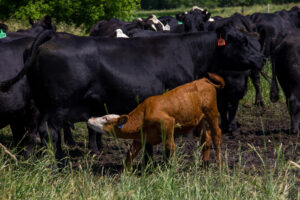
A brown calf nurses from a black cow in a grassy field, surrounded by a herd of black cattle. The animals have numbered ear tags, and trees are visible in the background.

How to Add Cow Body Condition After Weaning

July 28, 2022 | Beef

Body condition is king on every cow-calf operation. It impacts everything: post-partum cycling, successful breeding, abortion rates, weak calves at birth, birth challenges (dystocia), colostrum quality and weaning weights.

So, when’s the best time to add body condition? Right after weaning when lactation stops.

Understanding Lactation and Energy Supply in Cows

It’s important to understand a cow’s number one energy robber—her milk production.

According to Penn State University, a beef cow produces about 11½ gallons of milk per day during lactation. The requirement to meet this milk quantity is roughly 1-1.2 Mcal/lb. of metabolizable energy from grass, hay and good quality stored forages.

If grazed forages can’t meet this energy requirement, cows will begin to lose body condition quickly as they use energy reserves in muscle and fat to make milk. But, after weaning, this energy demand goes away, and the cow can start directing those nutrients back to body weight and condition score.

Simply put energy in a diet = body condition, so focusing on energy is key.

How to Add Cow Body Condition With Waning Forages

When calves are weaned in mid-to-late summer, grass quality starts to wane. So, while this is prime time to add body condition, ranchers must understand how a ruminant diet equates to energy and why supplementation might be needed to gain the appropriate amount of weight for next year’s calving season.

Picture a scale—the kind where you must balance both sides and it’s hard to get it right. The same applies to understanding energy in a cow’s diet. If the TDN:CP (total digestible nutrients: crude protein) ratio in a forage diet is unbalanced, the rumen microbes are unable to break down fiber, and cows won’t gain efficiently, which can inhibit the goal of adding body condition after weaning.

In the rumen, as crude proteins, or degradable proteins are broken down by microbes, ammonia-nitrogen (N) is released, which helps increase microbial activity and population. A benefit to increasing microbial activity and population is a more rapid and extensive forage digestion. This results in both an improvement in digestibility and forage intake, which together can have a marked increase in energy and body condition after weaning.

But, like everything in nature, there needs to be balance. The sweet spot for this balanced energy ratio is 8:1 TDN:CP. Too much TDN, CP (N) is deficient and microbes are inefficient. If there is too much CP, the animal will excrete excess N.

Fall forages have a higher TDN:CP ratio, usually around 10:1 or 12:1, depending on the forage type. The best way to balance this ratio is by adding low levels of a highly degradable crude protein or ammonia source to help rumen microbes be more efficient.

How to Increase Cow Body Condition After Weaning

Research from Kansas State University and Montana State University looked at the benefits of adding an ammonia source, Biuret, in grazing scenarios. The study evaluated the effects of Biuret on the intake and digestion of steers on prairie hay. Results showed a 22% increase in forage intake and a 52% increase in digested dry matter compared to non-supplemented steers.

Biuret has a unique ability to slow-release ammonia in the rumen over an extended period of time. This continuous supply of ammonia to microbes enhances their ability to break down forage while cattle are grazing or ruminating, meaning more calories are consumed and cattle gain more.

High-quality mineral like Ralco’s Rumatecis specially formulated to add the needed CP, in the form of Biuret, to fuel rumen microbes and help cows add BCS after weaning. Powered by patented Catyl-Zyme technology, Rumatec is research-proven to increase rumen microbe populations and add to body condition.

Schedule a free mineral consultation today by calling 507-337-6916 or emailing RuminantHelp@RalcoAgriculture.com
Rumatec Mineral Nutrition Logo

Rumatec Cow/Calf Mineral – Get a Calf Every Year

The Rumatec line of cow/calf supplements provides the needed nutrients commonly deficient in forages to help ensure optimum performance and reproductive efficiency.

Learn More

Share this post

Sidebar

Categories

  • News
  • Beef
  • Dairy
  • Poultry
  • Swine

Archives

  • July 2026
  • June 2026
  • May 2026
  • February 2026
  • January 2026
  • December 2025
  • November 2025
  • October 2025
  • September 2025
  • August 2025
  • July 2025
  • June 2025
  • May 2025
  • April 2025
  • March 2025
  • February 2025
  • January 2025
  • December 2024
  • November 2024
  • October 2024
  • August 2024
  • June 2024
  • May 2024
  • March 2024
  • February 2024
  • January 2024
  • December 2023
  • September 2023
  • August 2023
  • July 2023
  • June 2023
  • March 2023
  • February 2023
  • January 2023
  • December 2022
  • November 2022
  • October 2022
  • August 2022
  • July 2022
  • June 2022
  • May 2022
  • April 2022
  • March 2022
  • February 2022
  • December 2021
  • August 2021
  • July 2021
  • June 2021
  • April 2021
  • March 2021
  • January 2021
  • December 2020
  • October 2020
  • August 2020
  • July 2020
  • June 2020
  • May 2020
  • April 2020
  • March 2020
  • February 2020
  • December 2019
  • October 2019
  • July 2019
  • June 2019
  • May 2019
  • April 2019
  • February 2019
  • June 2018
  • March 2018
  • February 2018
  • December 2017
  • August 2017
  • May 2017
  • March 2017
  • December 2016
  • November 2016
  • October 2016
  • August 2016
  • July 2016
  • June 2016
  • January 2016
  • December 2015

Categories

  • News
  • Beef
  • Dairy
  • Poultry
  • Swine

Let’s Tackle Your Toughest Challenge

If there’s a problem holding your operation back, we’re here to help you solve it. If you’re ready for products that bring together nature and science, let’s talk!

Ralco News

Holstein dairy calf in a fenced in hutch

Heat Stress in Dairy Calves Starts Before You See It

Heat stress is usually talked about in terms of the milking herd. Lower dry matter intake, reduced …
Read moreHeat Stress in Dairy Calves Starts Before You See It
Two white broiler chickens stand close to a water dispenser; one chicken drinks from a red nozzle above, while the other looks on with its beak slightly open. The background shows more chickens out of focus.

How to Use Poultry Production Data to Make Better Flock Decisions

Production data is one of the most powerful tools in commercial poultry operations, but the biggest …
Read moreHow to Use Poultry Production Data to Make Better Flock Decisions
A group of black and white dairy cows stand in a circular milking parlor, attached to milking machines, inside a bright, modern barn.

Mastitis in Dairy Cows and Heifers: How to Manage Risk Before Production Loss

Mastitis remains one of the most costly and complex diseases in dairy production. The National …
Read moreMastitis in Dairy Cows and Heifers: How to Manage Risk Before Production Loss
Ralco logo with a green vertical bar and a leaf inside a yellow circle, next to the word "RALCO" in white, and the tagline "Nature Elevated by Science" below.
Four faded certification logos in a row, including HALAL, RMPP, GMP+, and FAMIQS, on a light background. Text and images within the seals are barely visible.

Subscribe for news and updates

Home
About
Our Science
Shop
Resources
Careers
Contact Us
Call 1 (800) 533-5306

  • Facebook
  • Instagram
  • YouTube
  • LinkedIn

Copyright © 2026 · Ralco Agriculture · All Rights Reserved · Privacy Policy

We use cookies to enhance your browsing experience, serve personalized ads or content, and analyze our traffic. By accepting, you agree to our use of such cookies. Privacy Policy