
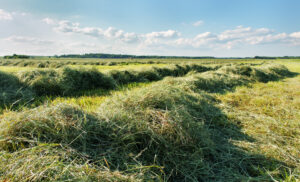
Some people look at this picture and can the smell of fresh-cut hay. Some people look at this picture and think it is probably 100 degrees outside, rain is on the way and I need to get the hay put up quickly before I go to the lake. Been there?
However, even in a rush, proper hay storage is critical to saving quality and quantity. Without proper storage, the risk of heating and spoilage is almost guaranteed and time and money are wasted.
Several hay storage methods exist for hay – whether it is dry, wet or chopped. Evaluating each method and the associated costs can help determine which storage method is right for your farm.
How to Store Dry Hay
There are four main ways to store dry hay: in a barn, plastic-wrapped, stacked outside or in John Deere B-Wrap®. All dry hay methods will require extra time for dry down to help minimize moisture content and spoilage. The golden rule is to bale hay at 18% without a preservative, and in anything beyond 25%, a hay preservative is needed.
1. Barn Storage
Pros: 2-5% dry matter loss. Great feed quality.
Cons: Very expensive. Building a barn is a large investment if you do not already have one. Storage of hay is limited by the size of the barn. Logistics can be challenging to ensure the oldest hay is always used first. Additionally, hay must be hauled in dry with little to no moisture to avoid spontaneous combustion.
Cost: Barn and labor
2. Plastic Wrapped
Pros: 5-10% dry matter loss. Medium feed quality.
Cons: More costly than not wrapping bales. Heat cannot escape well and tends to concentrate in the middle of the bale causing a brown core. Some spoilage occurs due to condensation, causing a slime or mold layer on the bale. Applying plastic requires additional labor, time and equipment.
Cost: Line wrap – $5/bale, Individually wrapped – $7/bale
3. Stack Outside
Pros: Cheapest method.
Cons: Has the most dry matter loss at 20-60%.
Recommendations: Place bales on sloped hills, pallets or rock so they can drain moisture. This can help reduce dry matter loss. The best method is to place bales in a single line, 3-4 feet apart facing north to south. Avoid pyramid stacking outside. This method reduces how much bales can breathe. If you do have to use a pyramid, always cover it.
Cost: Twine – $0.70/bale, Net wrap – $2.50/bale
4. John Deere B-Wrap
Pros: Sheds water well. Simulates barn storage conditions in the field and replaces net wrap. 2-5% dry matter loss.
Cons: Adds significant time to each bale wrapping cycle in the field.
Cost: $8/bale. Dry Hay
|
Dry Hay |
Dry Matter Loss |
Total $/Bale |
|
Barn Storage |
2-5% |
Depends on Barn |
|
Plastic Wrap |
5-10% | $5.00 (Line Wrap) $7.50 (Individual Wrap) |
|
Stack Outside |
20-60% | $0.70 (Twine) $2.50 (Net Wrap) |
|
John Deere B-Wrap |
2-5% | $8.00 |
How to Store Wet Hay
There are two main ways to store wet hay or baleage: by using plastic line wrap or plastic individual wrap. Baleage is often stored at moisture varying between 30-50%. Wet hay storage methods often have minimal leaf loss, so there is more nutrient density and palatable hay in bales.
Because baleage is put up at higher moisture, it is less dependent on weather conditions and requires fewer days of drying before it can be baled. Baleage does need to be fed soon after it is taken out of plastic, so it is important to store it near the place where it will be fed. Due to the variable moisture content, it is recommended to always use a hay preservative with baleage to ensure hay is cured evenly and nutrients are retained.
It is important to note that, unlike dry hay, wet hay will need to be processed in some way before it can be fed. It will need to go through a total mixed ration (TMR) or a hay grinder, while dry hay can just be fed directly from a bale feeder.
1. Plastic Line Wrap
Pros: Faster to do and less plastic used than individually wrapping. It is also easier to get the hay out of the plastic to feed. You do not need a bale squeeze; a bale spear works fine.
Cons: Requires handling and disposal of plastic for every bale that is fed. Hay must be hauled off the field to the line wrap machine within 1 day of baling.Roughly 5-10% dry matter loss. This method will be closer to 10% unless you get a hole in the plastic. Then, tremendous dry matter loss occurs in a short period of time.
Cost: $5/bale
2. Plastic Individual Wrap
Pros: Easy to move bales after they are made. Easier to transport than line wrap. The storage location is not critical. Bales can be wrapped in the field and picked up several days later.
Cons: Bale squeeze is required to move and handle bales without poking plastic. Tedious to unwrap each bale and take the plastic off. Substantially more plastic waste. This method will be closer to 5% dry matter loss unless you get a hole in the plastic. Then, tremendous dry matter loss occurs in a short period of time.
Cost: $7.50/bale
|
Wet Hay |
Dry Matter Loss |
$/Bale |
|
Plastic Line Wrap |
5-10% |
$5.00 (Net + Plastic) |
|
Plastic Individual Wrap |
5-10% |
$7.50 (Net + Plastic) |
How to Store Chopped Hay
There are two main ways to store chopped hay: a bunker or a bag. Chopping hay for haylage is the fastest way to harvest hay for feed, although it does require equipment such as a chopper and trucks to haul haylage to the bunker.
Chopping is thequickest way to harvest hay since you do not need to wait as long for hay to dry out. Chopped hay will also have to be put through a TMR before it can be fed.
The moisture level for chopped hay is between 45-55%, so it is recommended always to use an inoculant. Fermentation can be challenging with this method, and high dry matter loss is likely without an inoculant.
1. Chopped Hay Bag
Pros: Face management is great with this method, resulting in less dry matter loss and great feed quality. Consistent packing density ensures oxygen exclusion throughout the entire bag.
Cons: Need bagging equipment to store this way. You will have to fight plastic every day to feed it. Requires a large space as bags are typically a minimum of 200 feet long. Holes in the plastic from birds or varmints can lead to mold growth and dry matter loss.
Cost: $2.50 per ton for the bag.
2. Chopped Hay Bunker
Pros: Minimal dry matter loss. Great feed quality. Easier to feed out of than a bag.
Cons: Have to be careful with face management and about packing and covering chopped hay in a bunker. If not, this can lead to high dry matter loss.
Cost: $1-2 per ton for the tarp depending on pile size.
Best Preservatives to Save More Forage
No matter the storage or type of hay, let us help make hay management easier. Ralco has proven hay preservatives and inoculants that are easy to use and ensure your forage locks in nutrients. Anchor for Hayis a dry granular product that preserves higher-moisture hay and reduces the risk of heating and spoilage. Anchor Silage is an inoculant that drives efficient fermentation and rapidly reduces the pH of silage to limit spoilage and dry matter loss.
To learn more, contact Ralco’s forage experts at 507-337-6929.
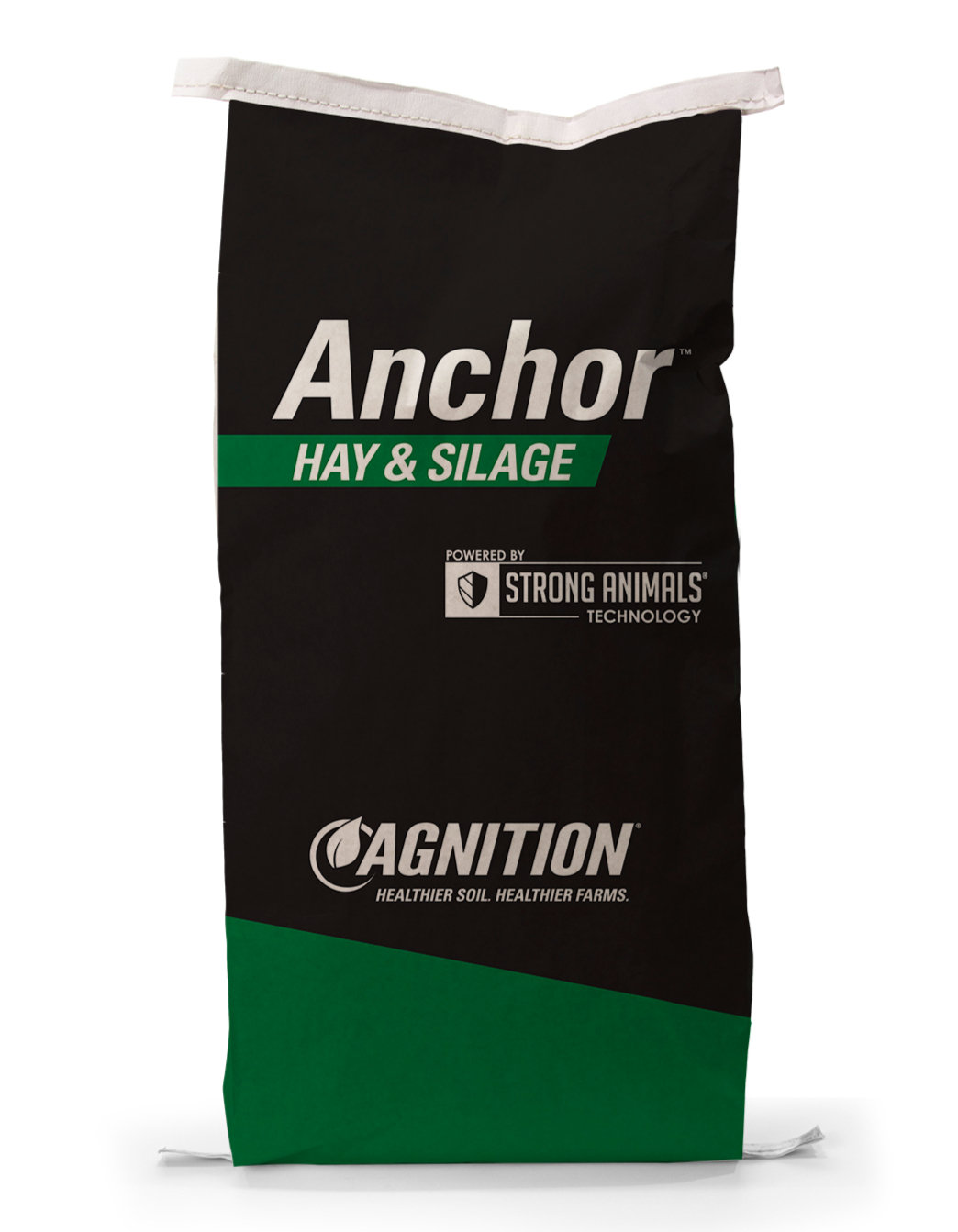
Anchor for Hay – Dry Granular Preservative Anchor for Hay is a dry granular product that preserves higher moisture hay and maintains hay quality over time while reducing the risk of heating and spoilage.
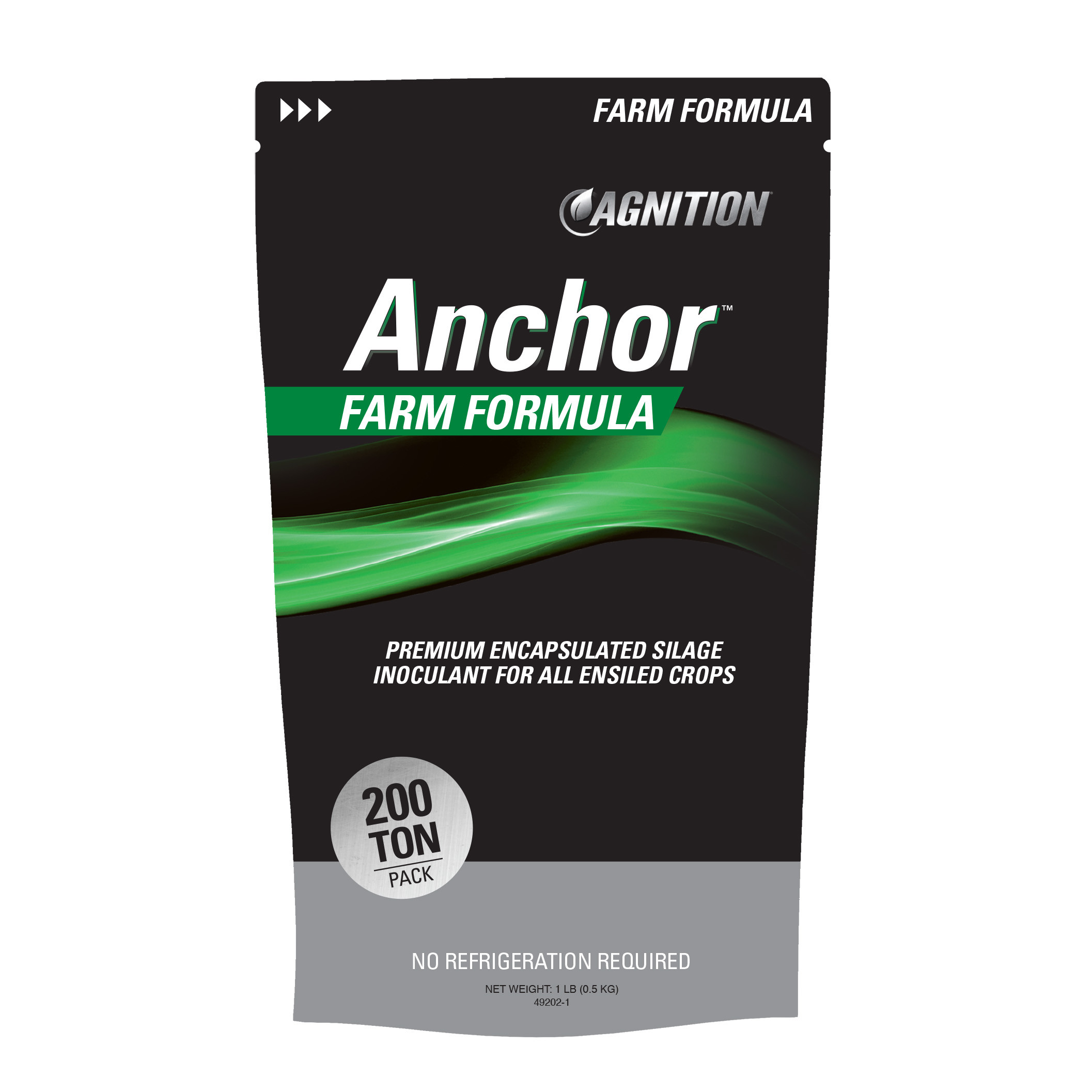
Anchor Silage – Inoculant Anchor Silage is an encapsulated inoculant blend, reinforced by Microbial Catalysttechnology to lower pH levels in forage and lock-in nutrients for maximum preservation without the hassle of refrigeration.