
Picture credit: Zootecnia Poultry Magazine
A flock can fall behind on growth, feed intake or litter can get wetter than it should, and none of it looks like a water problem. It looks like disease, nutrition issues or just a slow flock, and water is usually the last place anyone looks.
In fact, birds consume nearly twice as much water as feed, close to a 1.77 to 1 ratio in research on commercial broiler flocks. (1) Water and feed intake track that closely, so a problem in the water rarely stays contained to the water. It shows up across the whole flock.
When Water Changes What’s in the Feed Ration
One Ralco poultry producer in Montana kept running into the same frustrating pattern. Litter was wetter than it should’ve been and nothing on the health side explained it. The feed looked right and birds looked healthy. The usual suspects didn’t check out.
Turns out, the answer wasn’t in the feed at all. It was in the well. Water test results showed hard, high salt water that impacted the birds before the ration ever got involved.
A layer ration is typically formulated to a target sodium level near 0.15 to 0.20%, in line with published nutrient requirements for poultry. (2) However, that much sodium was already present in their water source and the diet was effectively getting double-dosed.
To solve the problem, Ralco poultry nutritionists pulled as much as a pound and a half of salt out of the ration, dialing dietary sodium back closer to 0.12%, just to reduce litter moisture caused by the excess water intake associated with higher sodium levels. Elevated sodium and chloride in either feed or water drive extra water intake as birds work to maintain their electrolyte balance, and that extra water usually ends up in the litter. (3)
This lesson isn’t specific to Montana or to sodium. A water test result should feed directly back into ration decisions, not sit in a file next to the sanitation records.
Hard water creates a second, quieter cost too. Mineral deposits and calcification on equipment like cool cell pads can restrict airflow and hurt cooling performance regardless of which species is in the barn.
When Water Trouble Doesn’t Look Like Water Trouble
On one broiler farm using Ralco products, four barns should’ve been tracking the same trajectory for growth. By day 18 or 19, three barns were running ahead of projected weight gain. The fourth was lagging, and the birds looked healthy. Nothing stood out on necropsy. Feed intake was simply behind.
The difference turned out to be the water flow rate. The lagging barn’s water lines were gummed up enough that flow was down to a quarter or a third of the other barns’ flow rate. Birds weren’t going without water, they just had to tap the line roughly four times as much to get the amount they’d normally get in one visit and the extra effort and movement reduced feed intake. Once lines were flushed and the scale was broken up, intake recovered within two days, but that flock never fully caught up to its projected curve.
This problem didn’t present as a water issue across the barn, it only showed up in flow rate measurement. A lot of water quality issues follow that same pattern. They masquerade as unexplained mortality, inconsistent growth or a flock that “just isn’t performing,” long before anyone traces it back to the water.
Build the Water Program on Testing, Not Assumptions
To avoid these water quality issues, the starting point for any water program is first figuring out water composition. A few parameters are worth testing every year regardless of history, including:
- pH
- Mineral content and hardness
- Microbials, including coliforms and yeast
It’s encouraged to test again any time something changes. Discolored water, a flood or leak near the water source or birds presenting with issues without obvious cause are all good reasons to pull a fresh sample.
Where the water comes from matters too, like our Montana story. Rural water and well water can behave very differently, and well water quality can swing significantly even between farms in the same county.
Now Build the Sanitation Layer
Once you know what’s in the water, a continuous sanitizer, most often chlorine, chlorine dioxide or hydrogen peroxide, is the next step.
Free chlorine is generally targeted between 2 and 5 ppm at the drinker line, and research on commercial broiler water supplies has used that same range to keep microbial loads under control during grow-out. (4) That reading should hold steady from the start of the line to the end. If it doesn’t, something along the way is consuming it.
Hydrogen peroxide is typically targeted between 25 and 50 ppm residual in university trials modeling brooding house waterlines. (5) More recent work found that residuals as high as 100 ppm didn’t impact early broiler growth performance or amino acid digestibility, so there’s some room above that baseline if a system needs it. (6) Peroxide is also useful for treating surface water sources like ponds or rivers, though it won’t fix taste or palatability on its own.
Sampling methods matter as much as the target number. Take drip samples and swab samples at multiple points down the line. Laboratory studies growing biofilm on the same PVC material used in poultry water lines have shown measurable biofilm forming within just two days, with communities further developing over the following week. (7) A biofilm is a thin layer of bacteria that sticks to the inside of a water line and protects itself with a slimy coating. Bacteria like E. coli can embed themselves inside that biofilm where a drip sample alone won’t catch it, and even after routine disinfection, broiler house water systems have been found to carry substantial bacterial loads on the inside surfaces of the line. (8)
Whatever system you’re running, validate it. Confirm the medicator or injector is actually diluting at the ratio it’s set to, commonly 1 to 100 or 1 to 128, that the product is blending evenly rather than dumping in slugs, and that flow isn’t being restricted. New systems should be checked when they go in, and established systems should still be revalidated periodically.
Between flocks is the window for mechanical cleaning, meaning chemicals plus physical scrubbing, filter changes and flushing lines to knock out lime scale before it becomes an anchor point for biofilm. Broilers generally get a 7-to-10-day cleanout to do this. Layers rarely get that kind of downtime, which means line quality comes down almost entirely to how consistently a producer stays on top of it during the flock.
Be Cautious Running Multiple Products Through the Line
Vaccines are the most sensitive product to run through a water line. Unlike most additives, a vaccine only works if the live organism in it survives long enough to reach the bird, and the same sanitizers that keep a line clean are designed to kill exactly that kind of organism. Manufacturer directions typically call for pausing the sanitation program around delivery and sometimes using a conditioning pack to buffer pH and bind contaminants.
Probiotics and prebiotics are another case worth watching closely. Both are meant to support the same population of good bacteria in the bird’s gut but running them at the same time in the line can cause them to clump, and that clump gives bacteria a surface to build on instead of staying suspended in the water. This makes it much harder to remove with a standard sanitizer than bacteria floating freely in the water.
High sugar electrolyte or vitamin products can also feed bacteria that are already established in lime scale or biofilm. This can act as the trigger that turns a minor buildup into a blocked line. Some acidifiers, like acetic acid, can also contribute to slime on their own but tend to perform better paired with a chlorine or peroxide system. Use these products for the specific window they’re intended for, then flush the line right after rather than leaving residual product sitting in warm pipes longer than needed.
None of this means additives are problematic. It just means flushing, monitoring and checking lines after using them is what keeps otherwise safe products from stacking into a problem.
Water Management is its Own Checklist
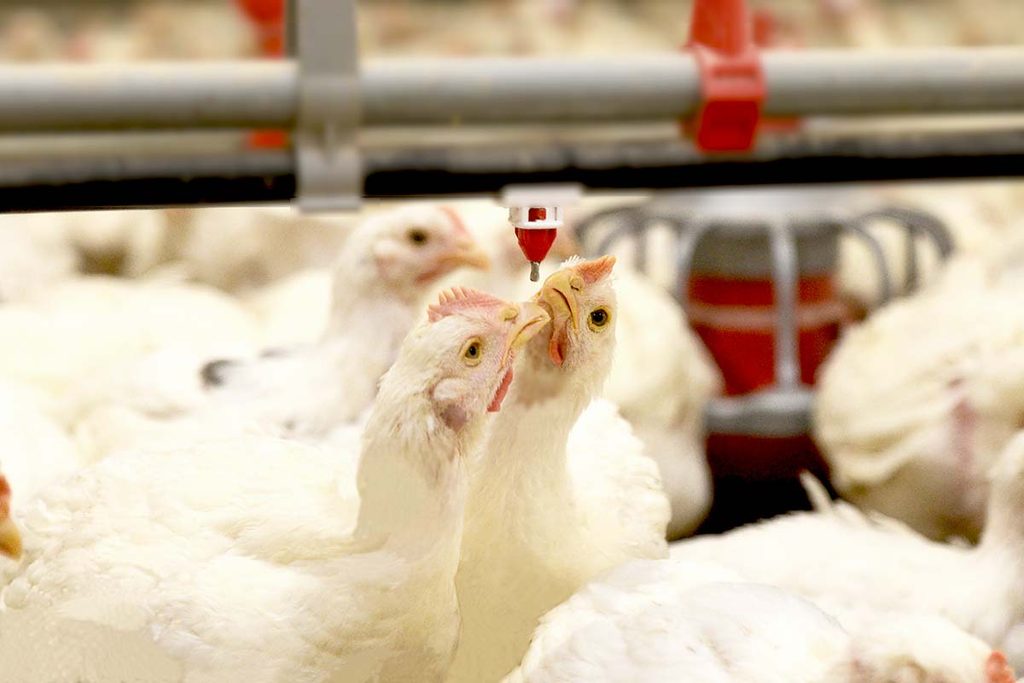
Clean, well sanitized water still won’t help much if the equipment delivering it isn’t set up correctly. For example, drinker lines set too high force birds to stretch or jump to drink, which can reduce intake. Lines set too low cause birds to drink at an angle, spilling water onto the litter, which drives up moisture and ammonia levels even while the water meter shows normal usage.
Water flow that’s too high essentially waterboards the bird. Flow that’s too low sends birds back to the line multiple times for the same drink, the same mechanism that dragged down feed intake in the story above.
Putting a program together doesn’t have to mean tracking all of this from memory. Here’s a checklist to start with.
Water Management Checklist
- Test water annually for pH, hardness, minerals and microbials. Test again any time water looks different or birds act differently.
- Send water test results to your nutritionist to inform ration decisions, not just sanitation decisions.
- Run a continuous sanitizer dialed to a validated target, generally 2 to 5 ppm free chlorine or 25 to 50 ppm peroxide and confirm it reads the same at both ends of the line.
- Sample with both drip and swab methods. A clean drip sample can still hide a dirty line, since bacteria protected inside a biofilm don’t always show up in the water itself. A swab is the only way to catch that.
- Validate medicators and injectors for correct dilution and even blending.
- Follow label instructions for pausing sanitizers around vaccines and other additives.
- Know how products like probiotics, prebiotics and high sugar additives behave in your system. Run them on a schedule that avoids overlap and flush the line after each use.
- Flush lines after any additive program to confirm nothing is lingering.
- Use both chemical and mechanical cleaning between flocks and change filters when dirty.
- Check drinker height and flow rate as part of routine barn walks.
At the end of the day, water quality problems can be subtle and show up as feed intake that’s a little behind, litter that’s a little wetter or mortality nobody can quite explain. Knowing your baseline, testing on a routine schedule and validating that your sanitation system is doing what the label says is what turns water from a blind spot into a lever you can manage.
Want to learn more? Listen to Season 6, Episode 24 of Wing it Wisely, where Carmen Paulsen talks with Dr. Tim Broderick and Alea Gigliotti from the Ralco Poultry Team about water testing, sanitation programs, product compatibility and real farm stories behind water driven performance problems.
Questions about your water sanitation program? Connect with the Ralco poultry team. Call 1-800-533-5306 or email PoultryHelp@RalcoAgriculture.com.
References:
- Pesti, G.M., Amato, S.V., & Minear, L.R. (1985). Water consumption of broiler chickens under commercial conditions. Poultry Science, 64(5), 803-808.
- 2. National Academies of Sciences, Engineering, and Medicine. (2026). Nutrient Requirements of Poultry (10th rev. ed.). National Academies Press.
- Poultry drinking water, understanding minerals’ impact. WATTPoultry.com. Summarizing university extension research on sodium, chloride, and TDS effects on water intake and litter moisture.
- Maharjan, P., Huff, G., Zhang, W., & Watkins, S. (2016). On-farm monitoring of the impact of water system sanitation on microbial levels in broiler house water supplies. Journal of Applied Poultry Research, 25(2), 266-271.
- Maharjan, P., Huff, G., Zhang, W., & Watkins, S. (2017). Effects of chlorine and hydrogen peroxide sanitation in low bacterial content water on biofilm formation model of poultry brooding house waterlines. Poultry Science, 96(7), 2145-2150.
- Biswas, B.K., Hoque, M.R., Raut, R., Tabler, T., Taylor-Bowden, T., Nahashon, S., & Maharjan, P. (2025). Applied research note: Understanding varying levels of hydrogen peroxide residuals in poultry drinking water in early broiler growth performance. Journal of Applied Poultry Research, 34(4), 100577.
- Trachoo, N., Frank, J.F., & Stern, N.J. (2002). Survival of Campylobacter jejuni in biofilms isolated from chicken houses. Journal of Food Protection, 65(7), 1110-1116.
- Maes, S., Vackier, T., Nguyen Huu, S., Heyndrickx, M., Steenackers, H., Sampers, I., Raes, K., Verplaetse, A., & De Reu, K. (2019). Occurrence and characterisation of biofilms in drinking water systems of broiler houses. BMC Microbiology, 19, 77.
- Litter Quality and Broiler Performance. CAES Field Report, Bulletin 1267. University of Georgia Cooperative Extension.