
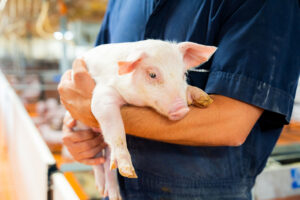
The most profitable barns are not the ones with the best feed efficiency. They’re the barns that sell the highest percentage of pigs at full-market weight.
As an industry, recent benchmarking data from MetaFarms shows that 25–30% of pigs are lost between farrowing and finishing. (1) If any other industry lost nearly a third of its product before sale, it would be seen as a major financial risk. Yet in pork production, this loss often receives less attention than growth rate or feed efficiency.
However, research and production economics continue to show that the greatest return comes from reducing pre-weaning mortality, post-wean mortality and cull pigs. It’s not from fine-tuning efficiency somewhere mid-system. Saving pigs has the highest impact on profit. (2)
In other words, the best return comes from preparing piglets early in life for survival and ultimate performance success.
Bigger Litters Have Changed the Starting Point for Piglets
Industry advancements have increased total pigs born alive, which reflects strong reproductive output but also increases the demands placed on the sow. Sow biology has not increased colostrum production enough to match this rise in liveborn pigs. Early estimations suggest anywhere between 35-55% of sows do not produce enough colostrum to meet the needs of their birth litter. (3)
Additionally, piglets enter the world with very limited energy reserves and depend on colostrum for gut development, immune strength and survival. However, as litter sizes have increased, the number of available teats and the amount of colostrum available per piglet has not kept pace. Research shows that sows are unable to adjust colostrum production for larger litters, resulting in each piglet consuming approximately 42 grams less colostrum for every additional piglet born. (4, 7)
Studies show that: (3)
- 200 grams of colostrum are needed for survival
- 250 grams of colostrum are needed to thrive
- Piglets receiving less than 290 grams may have 15% lower post-weaning weight
This early disadvantage is where fall-behind pigs start. It’s the point when added piglet Rx treatments, slower growth and greater variation at market weight begin. The first 48 hours set the trajectory for whether a pig becomes full market value or a fall-behind.
Invest Early for Results That Show Up at Market
As litter size has grown, the development of the digestive system of newborn pigs has also slowed. Piglets arrive post-weaning with less-developed gastrointestinal capacity and need time and the right diet structure to build it. (8) This is where feeding strategy becomes a performance driver for the pig and the rest of the production system.
Dr. Jacob Richert’s research shows that pigs respond best when diets are based on age and digestive development, not just weight. (7) All pigs are sensitive to nutritional shifts, with lifetime impacts most noticeable in barrows. (9) Pigs get the most benefit when early diets are more complex and highly digestible. This supports the development of digestive enzymes and gut tissue needed to handle starch, fiber and higher corn and soybean inclusion later. It’s more effective than introducing those ingredients too early and expecting pigs to simply adapt.
Once the gut is established, the diet can be simplified (more corn and soybean meal can be added). This is the point where lower-cost ingredients and by-product inclusions can enter the complete feed without compromising growth, feed efficiency or long-term finishing performance. The key is simply timing.
In the nursery, the goal is consistency, which is defined by steady intake, even growth and fewer fall-behinds. But the real performance advantage shows up later.
Pigs that start with a well-developed gut are more likely to stay on feed through stress, handle transitions smoothly and finish together faster at full-market weight.
In short: Build the gut early and simplify the diets later. The pay-off is captured in the finisher, not only at weaning.
Ralco’s Tactical Start Nursery Program
This concept is the foundation behind Tactical Start. The program builds gut capacity early with supportive, highly complex ingredient selection and nutrient structure, then simplifies diets as pig are prepared to handle them. This keeps pigs on feed and on schedule from nursery to market.
4 Natural Strategies to Reduce Pre-Weaning Mortality
Even when early diets are structured correctly, some pigs can still be disadvantaged. There is a common belief that these pigs will “catch up later,” but the data shows that once pigs fall behind in the first weeks, it becomes difficult for them to regain pace with the group. Most of these pigs continue to trail the others through finishing.
Supporting these pigs is not about adding more feed. It’s about giving the gut what it needs to mature and stay stable. Here are four natural approaches that work alongside early nutrition to help pigs maintain momentum from the start.
1. Colostrum Bioactive Support Small and late-born pigs are often the last to the teats, or have the most difficulty competing at the udder, and typically receive less colostrum. First Pulse D is a natural oral drench that supports these pigs by supplying concentrated colostrum-derived bioactives that help jumpstart growth, gut development and immune readiness.
These bioactives include IGF-1, lactoferrin and TGF-β, which continue to provide benefit even after gut closure, because they are smaller than the immunoglobulins (antibodies from the sow) that must be absorbed within the first 24 hours. First Pulse D also includes complex energy sources that are rapidly digested and provide an immediate source of energy, helping weaker pigs nurse on their own.
In a commercial case-control study, littermates receiving First Pulse D demonstrated improved livability and higher weaning weights compared to untreated pen mates. (4) Across multiple production systems, First Pulse D has been associated with 0.5-0.8 lbs. higher individual weaning weights and 1-8% reductions in pre-weaning mortality when focused on the smallest pigs in the litter.
2. Supplemental Milk to Reduce Competition In large litters, milk availability becomes a limiting factor as milk and colostrum output is spread thin across more piglets. Providing Birthright Milk in the crate offers an additional energy source, helps reduce competition at the udder and supports pigs who would otherwise fall behind. This early stabilization helps pigs enter the nursery with greater uniformity and more digestive resilience.
A study in southern Minnesota evaluated Birthright delivered through moveable cups in a patented in-line milk system designed for flexibility in farrowing rooms. The rooms using Birthright in 25% of the crates weaned 0.82 more pigs per sow per year, providing a net return of +$17.04 per sow per year, or +$17,040 per 1,000 sows annually.
By supplying supplemental milk early where it is needed most, Birthright helps more pigs enter the nursery with greater uniformity, improved energy status and a stronger chance to stay with the group.
3. Getting Weaned Pigs on Water & Feed Faster During weaning and other transitions, pigs often reduce feed intake. When this happens, the balance of bacteria in the gut can shift quickly. Without feed moving through the system, bacteria have the opportunity to multiply faster than the gut can regulate.
Getting pigs drinking after weaning is the fastest way to prevent this shift in gut balance. Essential-Lyte supports hydration and electrolyte balance and acidifies the water to help control harmful bacterial growth. It also includes Microfused Essential Oils to support a healthy, balanced gut environment and Actifibe Prebiotic that feeds beneficial microbes throughout the gut, giving pigs a better chance to maintain or return to feed and stay on track.
In a 24,000-pig field demonstration across 22 wean-to-finish barns, pigs receiving Essential-Lyte for the first seven days after weaning:
- Reduced mortality and culls by 41%
- Reduced sub-standards sold by 54%
- Improved feed efficiency by 14 points
- Increased full-value pigs sold by 41 pigs per 1,200-head group
These results translated to a 13.6:1 return on investment and a significant increase in revenue per barn. The improvement in full-value pigs sold (from 91.97% to 95.39%) highlights how quickly hydrated pigs return to normal eating behaviors, supporting healthier growth and better performance throughout the nursery phase.
4. Strengthening Gut Integrity & Immunity
As pigs move through the nursery, stress and dietary changes can disrupt the gut environment and reduce intake. Dual Defender provides this gut support through the feed using patented Microfused Essential Oil, which helps maintain a balanced gut environment, and Actifibe Prebiotic, which helps crowd out harmful bacteria and supports the tissues involved in immune readiness. These technologies work together to help pigs handle transition periods without losing momentum.
Research demonstrates how this combination helps pigs perform even under viral challenges. In a controlled study conducted at Pipestone Applied Research and published in the peer-reviewed journal Transboundary and Emerging Diseases (2020), nursery pigs receiving Dual Defender for 10 days showed stronger performance and health outcomes when compared to untreated pigs exposed to common swine viruses.
Results showed that nursery pigs receiving Dual Defender:
- Remained free of PRRSV-174 and SVA infection
- Showed no clinical signs of disease despite exposure
- Experienced zero mortality compared to losses in the control group
- Maintained greater weight gain throughout the trial period
This research highlights the role of gut health in disease resilience and shows how Dual Defender supports both immune strength and overall performance.
Looking Ahead
Genetics, equipment, nutrition and markets will continue to change but one principle remains constant: More pigs reaching full-market weight is the strongest return in any production system.
Investing early, supporting gut development and keeping pigs on feed through major stress points means more pigs in the group and ultimately more pigs to market.
Ready to strengthen your early-life program? Call 1 (800) 533-5306 to talk with a Ralco swine specialist.
Want to see how Ralco products perform first? Sign-up for a FREE Essential-Lyte trial!
References
- MetaFarms, Inc. (2024). MetaFarms 2024 Production Analysis: National Pork Board Benchmark Report. National Pork Board. Retrieved from https://www.porkcheckoff.org/wp-content/uploads/2025/10/MetaFarms-2024-Production-Analysis-NPB-Final.pdf
- Boyd, D.R. Integrating science into practice and getting it right. AASV Proceedings. 2012.
- Le Dividich, J., Rooke, J., and Herpin, P. Nutritional and immunological importance of colostrum for the newborn pig. Journal of Agricultural Science, 2005;143(6):469 to 485.
- Devillers, N. et al. Variability of colostrum production and intake. Journees de Recherches Porcine en France. 2005;37:435 to 442.
- Pomerenke, J.M. et al. Effects of bovine colostrum extract on disadvantaged pigs. Journal of Animal Science. 86 (Supplement 3):125.
- Hélène Quesnel, Chantal Farmer, Nicolas Devillers, Colostrum intake: Influence on piglet performance and factors of variation, Livestock Science, Volume 146, Issues 2–3, 2012,
- Devillers, C. Farmer, J. Le Dividich, A. Prunier, Variability of colostrum yield and colostrum intake in pigs, Animal, Volume 1, Issue 7, 2007, Pages 1033-1041,
- Michiels J, De Vos M, Missotten J, Ovyn A, De Smet S, Van Ginneken C. Maturation of digestive function is retarded and plasma antioxidant capacity lowered in fully weaned low birth weight piglets. British Journal of Nutrition. 2013;109(1):65-75. doi:10.1017/S0007114512000670
- Jacob A Richert, Taw Scaff, Lauren A Brizgys, Jon Ferrel, Allan P Schinckel, John Scott Radcliffe, Brian T Richert, 295 The Effect of Weaning age and Diet Complexity on Nursery Pig Growth Performance and Weight at Market, Journal of Animal Science, Volume 101, Issue Supplement_2, November 2023, Pages 181–182, https://doi.org/10.1093/jas/skad341.200